On a set of hard reasoning questions, Kimi K3.1 Pro on Pareto returned 335 correct answers and 409 wrong ones. In 211 of the 955 scored requests, a service failure left no answer the grader could use. The same model passed all 15 API checks in each of three groups covering streaming, tool calls and output constraints.
Scores for the same model on two providers
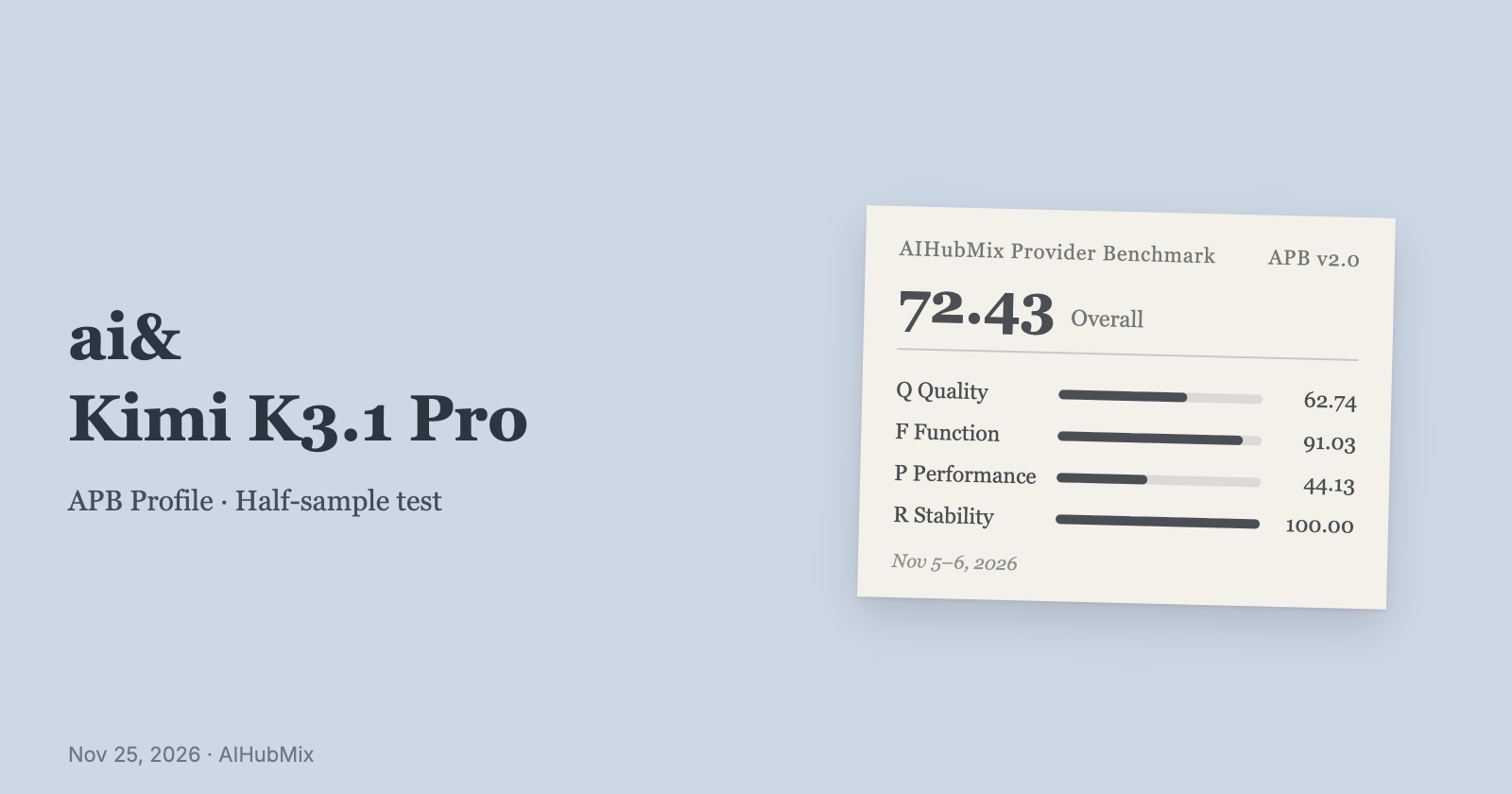
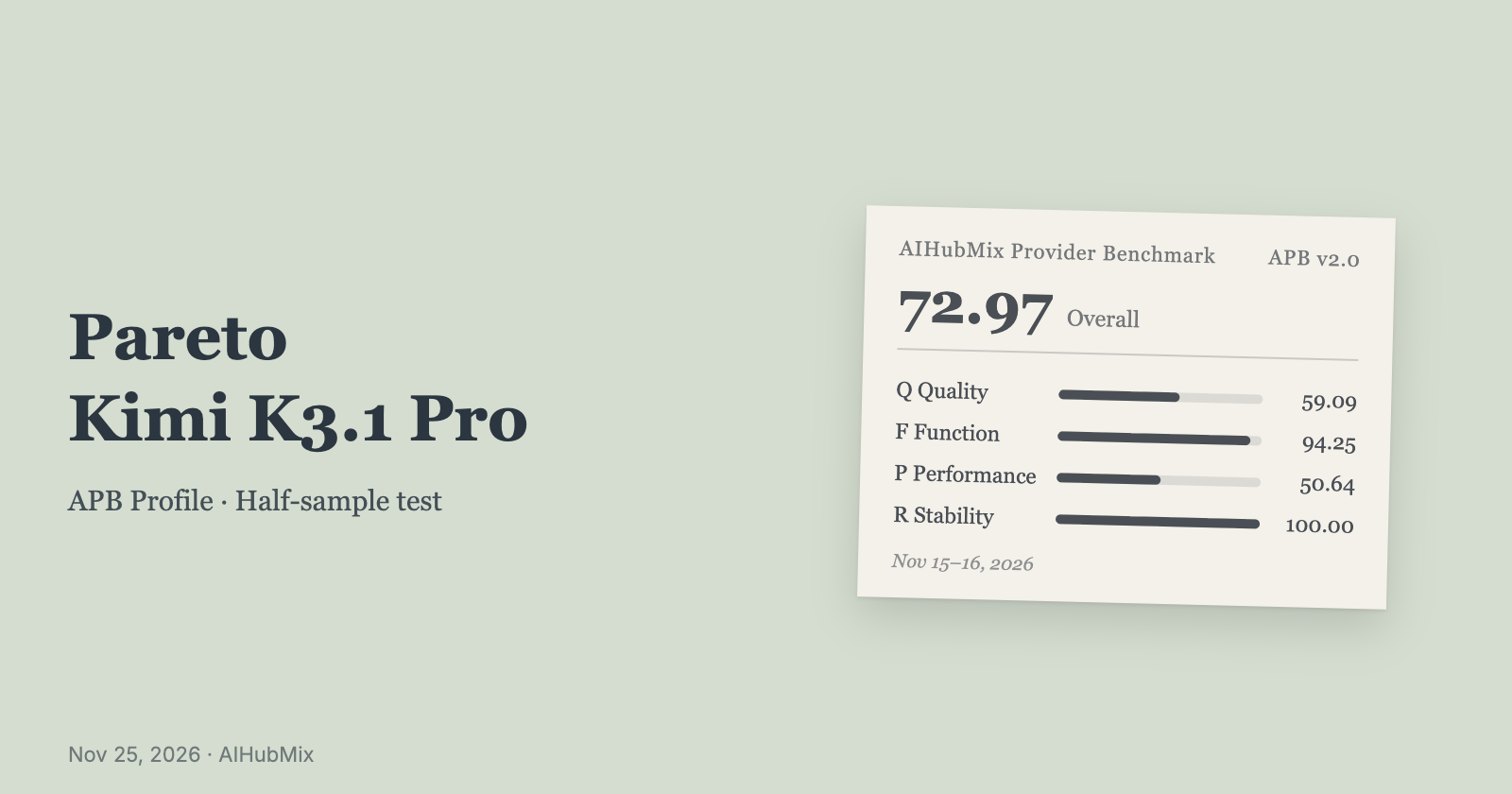
In November 2026, AIHubMix ran the half-sample version of its Provider Benchmark (APB) on Kimi K3.1 Pro at Pareto and ai&. The four measured scores and the overall score are each out of 100.
| Measure | Pareto | ai& |
|---|---|---|
| Answer quality (Q) | 59.09 | 62.74 |
| API functionality (F) | 94.25 | 91.03 |
| Performance (P) | 50.64 | 44.13 |
| Dedicated stability test (R) | 100.00 | 100.00 |
| Overall | 72.97 | 72.43 |
Answer quality (Q 59.09)
Pareto answered 1,180 of 1,997 scored attempts correctly. The three suites covered tool calls (BFCL), hard reasoning questions (HLE) and reasoning over long documents (LCR). Service failures had the largest effect on the hard questions.
- Correct answer 335 (35.08%)
- Wrong answer 409 (42.83%)
- Service failure 211 (22.09%)
Some failed requests were still streaming at the 300-second deadline. Others returned an HTTP error. Of the 744 requests that returned an answer the grader could evaluate, 335 were correct (45.03%). Counting the 211 service failures as misses brought accuracy on the hard questions to 35.08%.
| Suite | Collected | Correct / scored | Accuracy | Service failures |
|---|---|---|---|---|
| BFCL tool calling | 957 | 766/949 | 80.72% | 3 |
| HLE reasoning | 1,059 | 335/955 | 35.08% | 211 |
| LCR long context | 96 | 79/93 | 84.95% | 3 |
| Total | 2,112 | 1,180/1,997 | 59.09% | 217 |
BFCL scores tool calls automatically. When a task called for parallel calls to the same tool, accuracy was 91.01%. When the model had to complete a sequence across multiple turns, it succeeded on 54 of 92 tasks.
Results for all six BFCL tool tasks
| Tool task | Correct / scored | Accuracy |
|---|---|---|
| Single tool | 191/226 | 84.51% |
| Choose among multiple tools | 164/192 | 85.42% |
| Parallel calls to one tool | 172/189 | 91.01% |
| Parallel calls to multiple tools | 105/153 | 68.63% |
| No relevant tool | 80/97 | 82.47% |
| Multi-turn tool sequence | 54/92 | 58.70% |
API functionality (F 94.25)
On November 15, all five requests that asked Pareto to send the answer in one piece returned HTTP 400 with streaming_only. The functionality checks then used streaming. Pareto passed 72 of 76 judged checks. Twice, a conversation that included an earlier tool call returned unexpected content or an unexpected finish state. Twice, the endpoint accepted a malformed tool definition with HTTP 200.
| Group | Weight | Passed / judged | Excluded |
|---|---|---|---|
| Streaming | 20% | 15/15 | 0 |
| Tools | 20% | 15/15 | 0 |
| Output constraints | 20% | 15/15 | 0 |
| Context | 15% | 6/8 | 7 |
| Errors | 15% | 13/15 | 0 |
| Metering | 10% | 8/8 | 7 |
F weights the groups separately. Of the excluded checks, 13 required exact native token counts and one was inapplicable.
How long it took to see an answer (P 50.64)
The median wait for the first answer text was 7.50 seconds with one request at a time and 10.54 seconds with ten in flight. Each group had 45 requests. Requests without a valid result ranked last in the first-text calculation. Time spent on reasoning before the answer appeared counted toward the wait.
| Wait | One at a time (43) | Ten at once (42) |
|---|---|---|
| Under 5 s | 11 | 4 |
| 5 to under 10 s | 23 | 15 |
| 10 to under 20 s | 7 | 23 |
| 20 s or more | 2 | 0 |
| Provider | Concurrency | First text (s) | TPOT (ms) | Valid requests |
|---|---|---|---|---|
| Pareto | 1 | 7.50 | 10.00 | 43/45 |
| ai& | 1 | 5.91 | 4.68 | 42/45 |
| Pareto | 10 | 10.54 | 11.69 | 42/45 |
| ai& | 10 | 8.57 | 7.12 | 45/45 |
At one request at a time, 34 of 43 valid requests started answering in under 10 seconds. With ten in flight, 19 of 42 did. TPOT is the average interval between answer tokens once the text starts. The table gives the median for each group, counting invalid requests at 50 milliseconds. Combined throughput at ten concurrent requests was 305.96 tokens per second. Pareto scored 43.99 on response speed alone and 50.64 on performance with caching included.
How much of a repeated prompt came from cache?
When several questions start with the same document, the endpoint can read the repeated text from cache. All four repeats with an 8k prefix read every eligible token. With a 32k prefix, the four repeats read 32,000, 32,000, 0 and 27,648 tokens, for a combined reuse rate of 71.60%.
| Prefix | Hot hits / valid | Cached / eligible tokens | Token reuse |
|---|---|---|---|
| 8k | 4/4 | 31,744/31,744 | 100.00% |
| 32k | 3/4 | 91,648/128,000 | 71.60% |
| Total | 7/8 | 123,392/159,744 | 77.24% |
Across eight valid repeats, Pareto read 123,392 of 159,744 eligible input tokens from cache, giving it a cache score of K = 77.24. Caching accounts for 20% of measured performance. Measured performance supplies 65% of the composite performance score, which carries 20% of the overall score. Those weights give caching 2.6% of the total. Pareto’s cache hits contributed about 2.01 points out of 100 (77.24 × 2.6%).
Service stability (R 100.00)
All 150 requests in the stability test succeeded, including 61 short requests, 44 long requests, 30 tool requests and 15 multi-turn conversations. The 95% confidence interval for the success rate in this set was 97.57% to 100%. Service failures on the hard questions counted toward answer quality.
Test setup
On November 15–16, 2026 (UTC+8), the test sent HTTP/1.1 streaming requests directly to Pareto’s /v1/chat/completions endpoint using moonshotai/kimi-k3.1-pro. Reasoning effort was set to high, with a temperature of 1.0 for the answer tests and a limit of 16,384 output tokens for long reasoning tasks. The request deadline was 300 seconds. Automatic retries and cross-provider fallback were disabled.
The answer tests collected 2,112 attempts across 774 questions. Functionality and speed each had 90 checks or requests, with another 150 requests in the stability test. Pareto’s deepseek/deepseek-v4.1-flash graded HLE and LCR.