Gemini 4 Hydrogen costs twice as much per token as Gemini 3.8 Flash's introductory rate: $1.50 per million input tokens and $7.50 per million output tokens, against $0.75 and $3.75. On Artificial Analysis's live measurements, Hydrogen completes an index task for $1.87; Gemini 3.8 Flash takes $7.77. The token price doubled, and the cost per completed task fell by about three quarters.
That is the unusual part of this upgrade. Google recommends Hydrogen as the upgrade from Gemini 3.8 Flash and earlier Gemini 3 and 2.5 models, but it is not a Flash refresh. The model card says plainly: "Gemini 4 Hydrogen is adapted from Gemini 4 Carbon." It inherits the Gemini 4 context window, the Gemini 4 long-decode path and a new thinking level, xhigh, while keeping a Flash-shaped job: fast, high-volume execution.
The result is a model that is easier to justify on a per-task budget than on a per-token one. Below: what changed, what the measurements say, where the upgrade stops, and how to call it through AIHubMix.
What Hydrogen is
Hydrogen went generally available on 2026-11-12, according to the Gemini API changelog; its model card is dated the same day. Google calls it "our daily driver for agentic workflows" in the launch post and positions Carbon and Argon as the models "built for deep, long-horizon reasoning." Hydrogen is the one "built for rapid execution across diverse agentic workflows," in the model card's words, and it can run on its own or as a sub-agent beside the frontier models.
Three launch facts matter for API users. It is the only Gemini 4 model on the free tier: Google says it is available "on both the free and paid tiers in Google AI Studio and the Gemini API." It is also the only Gemini 4 model with xhigh thinking. And it is the default model for the Antigravity agent in Gemini Managed Agents, according to the changelog.
One caveat belongs near the top. Google's enterprise documentation calls Hydrogen "a short-term generally available (GA) release subject to a minimum 45-day retirement notice policy." The deprecations page lists no shutdown date, but a team planning a long-lived dependency should read that sentence as a warning to keep the model string configurable.
What changes from Gemini 3.8 Flash
The two models share more than their price tier suggests. On Google's API, both take a 1,048,576-token context, both accept text, image, audio and video input, and both are available on a free tier. AIHubMix's model page lists text, image, audio, video and PDF input for Hydrogen, with text output; Google's enterprise page also lists Office and OpenDocument, which the gateway page does not. The differences are in output headroom, thinking defaults and the shape of the API surface.
| Item | Gemini 4 Hydrogen | Gemini 3.8 Flash |
|---|---|---|
| Context window | 1,048,576 tokens | 1,048,576 tokens |
| Maximum output | 1,048,576 tokens via long decode | 65,536 tokens |
| Synchronous output | 65,536 tokens per hop, streaming or not | 65,536 tokens |
| Thinking levels | low, medium, high (default), xhigh | low, medium (default), high |
| Input modalities | text, image, audio, video, PDF, Office | text, image, audio, video, PDF |
| Free tier | Yes | Yes |
| Caching | implicit only, 4,096-token minimum | implicit and explicit |
Hydrogen adds a fourth level, xhigh, and moves the default from medium to high. It also allows a 65,536-token synchronous hop in both streaming and non-streaming mode; Carbon and Argon allow 65,536 only when streaming and 32,768 otherwise. For long output, Hydrogen uses the same background or continuation-token path as the rest of the Gemini 4 family and can reach 1,048,576 tokens minus the input.
The turn-level cost follows from the default. Hydrogen spends more thinking tokens per turn than a model that defaults to medium, and output tokens include thinking. A workload migrated without setting a level will usually spend more per turn than it did on 3.8 Flash, even before the per-token price difference.
The measured upgrade: 20 index points for less per task
Artificial Analysis measured Hydrogen at its high setting at 51 on the Intelligence Index, rank #21 of 78. Gemini 3.8 Flash at its high setting scored 31, rank #54. The task bill moved the other way: $1.87 against $7.77.
| Model / effort | AA rank | AA Index | $/task | Min/task | First answer token |
|---|---|---|---|---|---|
| Hydrogen high | 21 | 51 | 1.87 | 8.3 | 18.89 s |
| Hydrogen xhigh | 16 | 54 | 3.16 | 13.5 | 37.77 s |
| Gemini 3.8 Flash high | 54 | 31 | 7.77 | 14.7 | 17.53 s |
These figures are Artificial Analysis's live measurements, accessed at 2026-11-13T02:40Z, on Intelligence Index v5.0.1 with 78 ranked models. They use standard list prices and are not AIHubMix bills. Both rows are high-effort results, so the comparison is matched at high; note that high is Hydrogen's default but not Flash's. Flash at its default medium scores 30 at $6.26 per task, so a default-vs-default comparison changes the numbers without changing the direction.
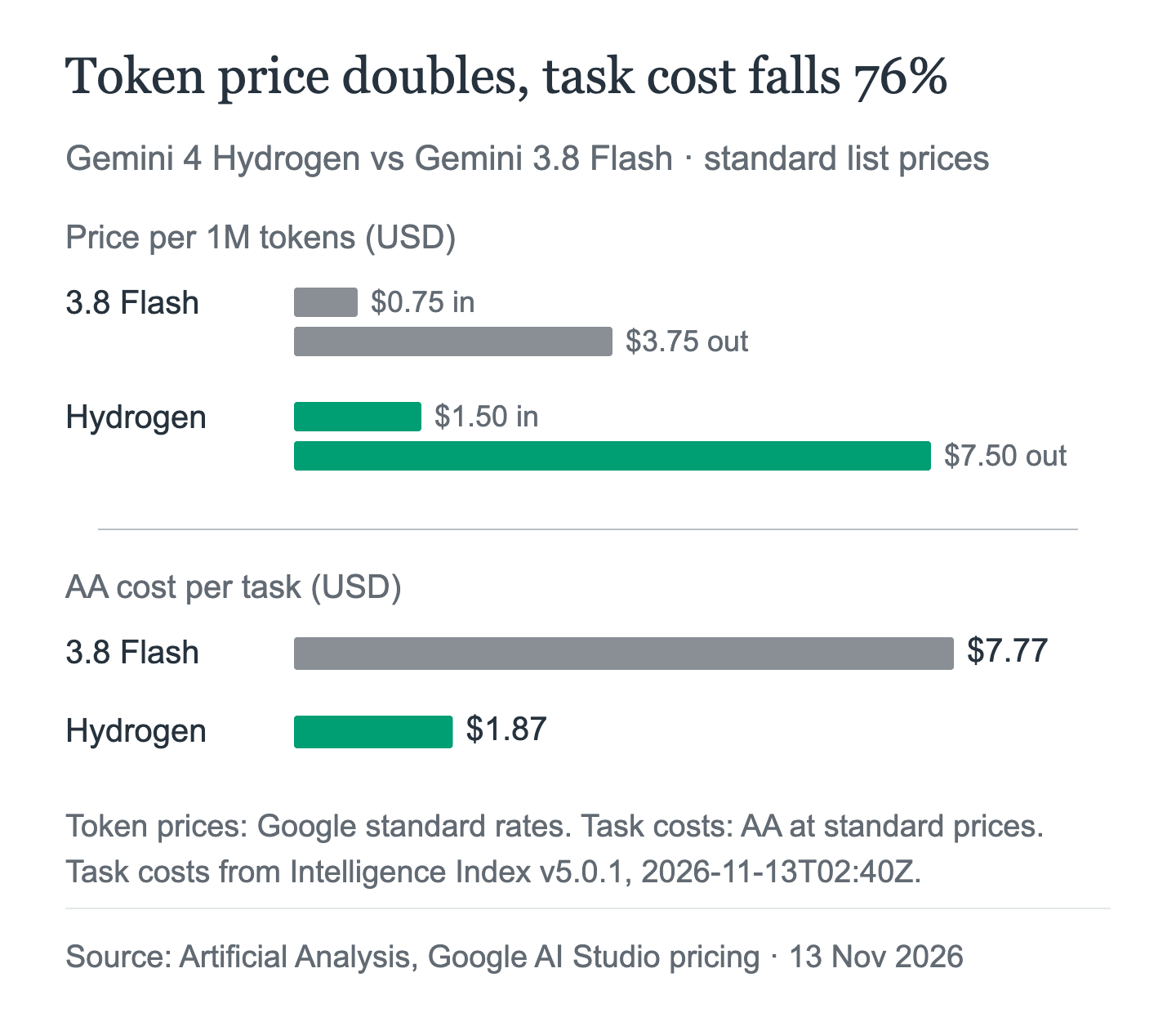
The per-task result is the one to keep. Hydrogen's token price is twice Flash's introductory rate, yet its measured cost per task is 75.9% lower. The gap comes from how many tokens each model spends to finish the same work, which a per-token price cannot show. Hydrogen's first answer token arrives at 18.89 seconds, about 1.4 seconds slower than Flash's 17.53, and it finishes the task in 8.3 minutes against 14.7.
At xhigh, Hydrogen scores 54 for $3.16 per task and 13.5 minutes, with the first token at 37.77 seconds. That is four points above Gemini 4 Argon high (50) and six below Carbon high (60) in the same snapshot. The four levels are covered separately in this series; the short version is that high is the value setting and xhigh is for hard tasks.
Google's benchmark table, and the three rows Hydrogen loses
Google's model card is a vendor document: self-reported, published on 2026-11-12, and built around two rivals rather than the previous Gemini model. Hydrogen leads 7 of the 10 listed comparisons. The three losses are the useful part.
| Benchmark | Hydrogen | Claude Sonnet 5.5 | GPT-6.1 Terra |
|---|---|---|---|
| SWE-sweep | 13.5% | 3.1% | 5.8% |
| Terminal-Bench 4.1 | 57.0% | 63.9% | — |
| Agents' Last Exam v1.1 | 71.6% | 60.4% | 69.8% |
| AutomationBench-AA | 76.1% | 71.8% | 60.2% |
| Vending-Bench 2 | $14,549 | $11,165 | $9,107 |
| OSWorld-2.1 | 77.6% | 83.9% | 74.2% |
| MKA | 53.4% | 52.0% | 43.8% |
| Chartography | 66.6% | 61.6% | 63.2% |
| Terminal-Bench-Science 0.1 | 51.4% | 59.9% | 58.3% |
| HLE-Diamond | 58.8% | 53.3% | 47.3% |
Terminal-Bench 4.1 is marked "cheating-adjusted" in the model card. Sonnet 5.5 wins Terminal-Bench 4.1 (63.9 against 57.0), OSWorld-2.1 (83.9 against 77.6) and Terminal-Bench-Science 0.1 (59.9 against 51.4). Those are the rows where a more expensive model still buys something. Anthropic's price list has Sonnet 5.5 at $2 input and $10 output, so Hydrogen is 25% cheaper per token and wins most of the card while losing the three most agentic or scientific rows.
Do not put Carbon's numbers beside this table. Carbon's model card reports Terminal-Bench 4.0 at 65.2; Hydrogen's card reports Terminal-Bench 4.1 at 57.0. Different benchmark versions, different comparison sets, no valid column.
Google's launch post adds claims the model card does not repeat: Hydrogen finishes tasks "2.5 times faster at its high default setting" than Gemini 3.8 Flash and cuts fabricated claims by "more than 5x." It also claims #5 on Agent Arena, first place on the Vals Tax Agent Bench (52.3%) and a tie for first on the Vals Legal Research Bench (55.8%). These are vendor-reported and not independently reproduced here.
Price: twice the token rate, lower cost per task
Hydrogen's standard price is $1.50 input, $7.50 output and $0.075 cached input. Batch and Flex are half that, and Priority is $2.70 and $13.50. The price is flat across the full context window.
| Model / tier | Input | Cached input | Output | When |
|---|---|---|---|---|
| Hydrogen Standard | $1.50 | $0.075 | $7.50 | Now |
| Hydrogen Batch / Flex | $0.75 | $0.0375 | $3.75 | Now |
| Hydrogen Priority | $2.70 | $0.135 | $13.50 | Now |
| Gemini 3.8 Flash Standard | $0.75 | $0.075 | $3.75 | Through 2026-12-31 |
| Gemini 3.8 Flash Standard | $1.50 | $0.15 | $7.50 | From 2027-01-01 |
| Gemini 4 Carbon / Argon | $2.00 | $0.10 | $10.00 | Through 2026-11-30 |
| Gemini 4 Carbon / Argon | $4.00 | $0.20 | $20.00 | From 2026-12-01 |
Official prices in USD per million tokens, from Google's pricing page, accessed 2026-11-13. Hydrogen has no announced future change.
Two comparisons follow from the table. Hydrogen's input and output rates are exactly Gemini 3.8 Flash's standard rates from 2027-01-01, so the "twice as expensive" gap disappears on New Year's Day. Against Carbon and Argon, Hydrogen is 25% cheaper per token through November 30, and 62.5% cheaper once their prices double on December 1.
AIHubMix lists Hydrogen at $1.50, $7.50 and $0.075, matching Google's standard price. The free tier is Google's, not the gateway's: AIHubMix is a paid route.
Where Hydrogen is not the upgrade
The protocol surface is narrower. Carbon and Argon have schema entries listing Chat Completions, Responses, Anthropic Messages and native Gemini. Hydrogen has no schema entry in the 2026-11-11 model-index snapshot, and only POST /v1/chat/completions is documented. Codex-style Responses clients and Claude Code-style Anthropic clients should not assume Hydrogen works without a check.
It is a short-term GA release. The 45-day retirement notice policy is a planning constraint, not a reason to avoid the model. It is a reason to keep the model ID in configuration rather than in code.
Some platform features are missing. Google's enterprise page marks Gemini Live API, RAG Engine, Tuning and fixed quota as not supported for Hydrogen; Batch inference is supported.
The safety profile is mixed. The model card reports better text safety than Gemini 3.8 Flash (+0.80pp text-to-text, +1.10pp multilingual) but 5.57 percentage points more unjustified refusals, particularly on multimodal prompts, and tone 0.65 points worse. These are automated evaluations, not red teaming.
Carbon is still the quality ceiling. Hydrogen high scores 51 against Carbon high's 60, and Hydrogen xhigh's 54 is still six points short. For hard debugging, architecture, scientific work and security analysis, the extra thinking in Carbon is the product.
The lower levels are not free quality. Hydrogen medium scores 41 and low scores 27 on AA. A migration that keeps the old default in spirit by dropping to medium will lose far more quality than the token price saves.
How to call it through AIHubMix
The documented route is the OpenAI-compatible chat-completions endpoint. The model page lists two providers, VertexAI and Google AI Studio, with automatic retry.
import os
from openai import OpenAI

client = OpenAI(
    base_url="https://aihubmix.com/v1",
    api_key=os.environ["AIHUBMIX_API_KEY"],
)

response = client.chat.completions.create(
    model="gemini-4-hydrogen",
    messages=[{"role": "user", "content": "Summarise this incident report and list the follow-ups."}],
    max_tokens=16384,
)

print(response.choices[0].message.content)
The endpoint is POST /v1/chat/completions. AIHubMix lists text, image, audio, video and PDF input for Hydrogen, with text output; it does not publish capability flags for reasoning, tool use or structured output, and its Gemini guide covers Gemini 2.5-era thinking controls rather than Gemini 4 levels. Do not assume that Google's thinking_level parameter, or the new xhigh value, passes through the gateway. Keep max_tokens within the 65,536 synchronous limit unless long decode is confirmed for your route. No live test was run for this post, so the sample shows the request shape rather than a verified response.
Who should switch now
Switch now if you are on Gemini 3.8 Flash and paying per token: Artificial Analysis measures a 76% lower cost per completed task at a 20-point higher index, and the free tier gives you a no-cost way to check quality on your own prompts. Switch if your workload is high-volume and can run on Chat Completions with text output, or if you want a cheaper execution model beside Carbon in a multi-model loop.
Wait if your client depends on the Responses or Anthropic Messages protocol; if your task is at the hard end of debugging, architecture or security, where Carbon's ceiling still matters; or if a 45-day retirement notice is incompatible with your release cycle.
Test first if you are between. Run 20 to 50 real requests on Hydrogen high and Gemini 3.8 Flash at its default, and compare cost per completed task rather than cost per token. The AIHubMix compare page is useful for the Carbon side of that decision.
FAQ
Is Hydrogen cheaper than Gemini 3.8 Flash?
Per token, no: $1.50/$7.50 against the introductory $0.75/$3.75. Per completed task, Artificial Analysis measures $1.87 against $7.77, about 76% less. The per-task figure depends on token use, not just the rate card.
Is Hydrogen a renamed Gemini 3.8 Flash?
No. Google's model card says Hydrogen is adapted from Gemini 4 Carbon, and Google recommends it as the upgrade from 3.8 Flash. It has a different context path, a fourth thinking level and a different default.
Does Hydrogen accept images?
Yes. Google's platform accepts text, image, audio, video, PDF and Office files. AIHubMix's model page lists text, image, audio, video and PDF input with text output; Office and OpenDocument are not listed there.
Is the free tier available on AIHubMix?
No. The free tier is Google's, in AI Studio and the Gemini API. AIHubMix is a paid route at $1.50/$7.50.
What is the default thinking level?
high. Gemini 3.8 Flash defaulted to medium; Hydrogen adds xhigh above high.
Is Hydrogen better than Carbon?
No. Carbon high scores 60 on the AA index against Hydrogen high's 51 and xhigh's 54, and costs more per task. Hydrogen is the cheaper execution model, not the frontier model.
Can I set the thinking level through AIHubMix?
Not from the documentation. AIHubMix publishes no reasoning capability flag for Hydrogen, and its Gemini guide does not cover Gemini 4 levels. Verify before relying on it.
Keep reading: the Gemini 4 Hydrogen series
- If the question is which thinking level to run, the next post measures all four levels on the same index and shows where the ladder stops paying: Gemini 4 Hydrogen Thinking Levels: low, medium, high, xhigh.
- If the question is whether to use Hydrogen beside Carbon or Argon, the third post sets the three models side by side with prices, latency and a workload table: Gemini 4 Carbon vs Hydrogen vs Argon: Which Model for Which Job?.
Sources
- Google, Introducing Gemini 4 Hydrogen
- Google AI Studio, Gemini 4 Hydrogen: what's new
- Google DeepMind, Gemini 4 Hydrogen model card
- AIHubMix, Gemini 4 Hydrogen
- Artificial Analysis, Gemini 4 Hydrogen — live snapshot 2026-11-13T02:40Z, Intelligence Index v5.0.1