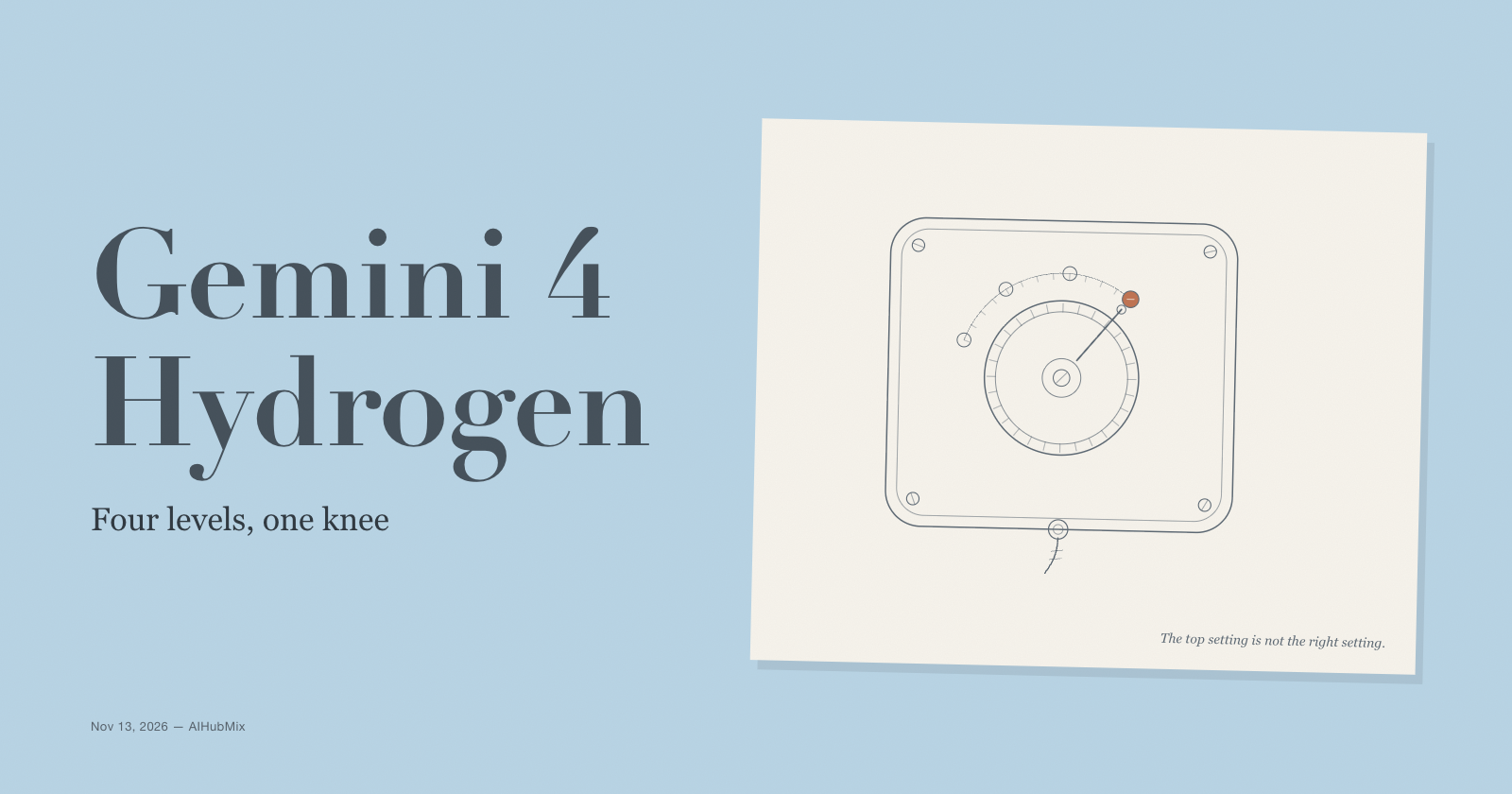
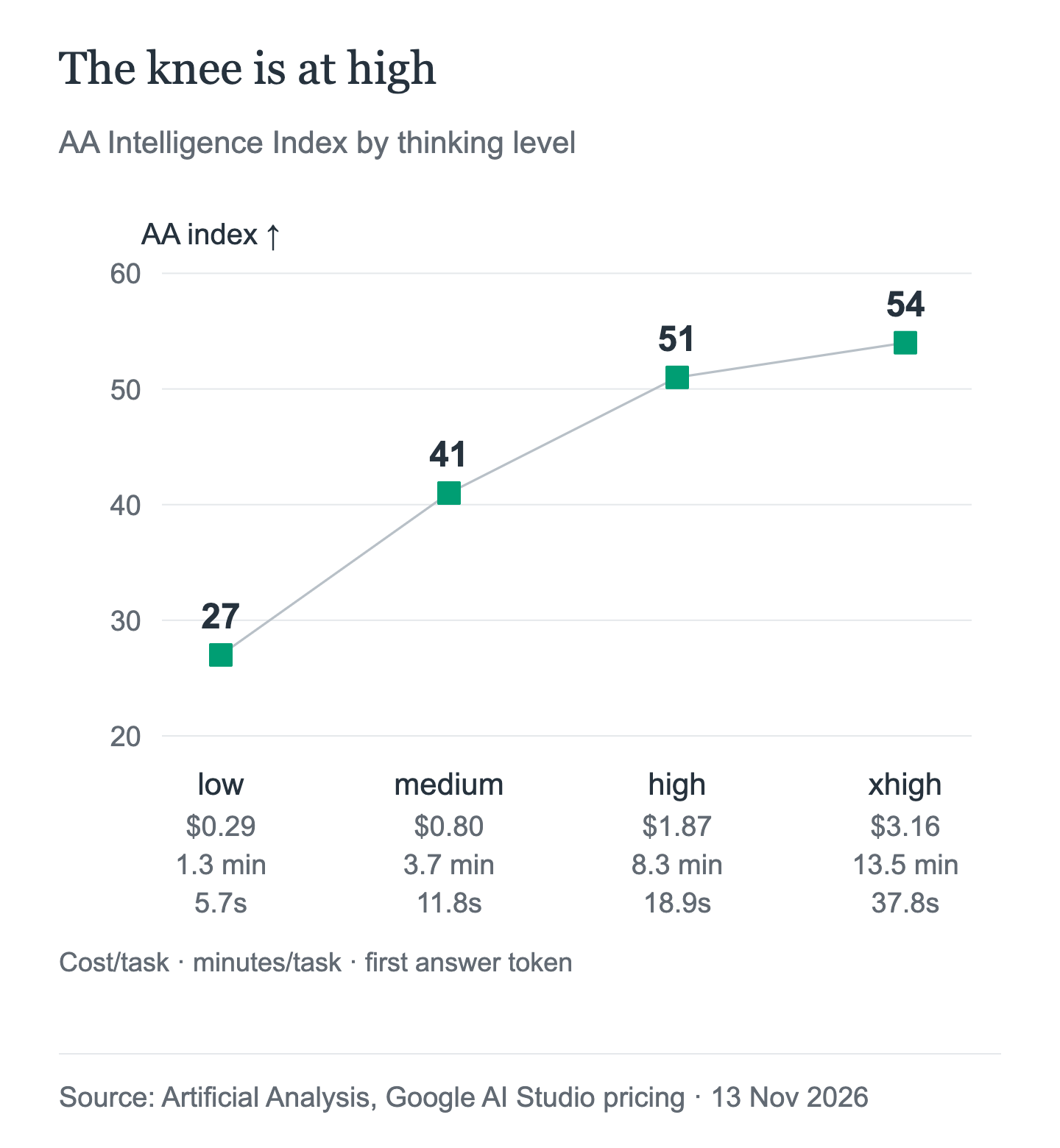
Gemini 4 Hydrogen has four thinking levels, and they behave like four different models. On Artificial Analysis's live measurements, the same model scores 27 at low, 41 at medium, 51 at high and 54 at xhigh. The default is high, and xhigh is new to the Gemini 4 family: Carbon and Argon stop at high.
The spread is wide: the same model spans 27 index points from low to xhigh. Moving from medium to high buys 10 index points for about $1.07 more per task. Moving from high to xhigh buys 3 points for $1.29 and nearly doubles the wait for the first answer token. The practical answer is to start at high, reserve xhigh for hard multi-step work, and treat low and medium as latency settings that need their own quality check.
Below: what each level is for, what it costs, what changes in the API, and what AIHubMix does and does not document.
The four levels and what changed
Gemini 4 Hydrogen supports low, medium, high and xhigh. Google's release notes put it plainly: "The model defaults to high and introduces xhigh." That is two changes against Gemini 3.8 Flash, which defaults to medium and stops at high.
The rest of the family did not move. Carbon and Argon support low, medium and high, with medium as the default. Hydrogen is the only Gemini 4 model with a setting above high.
| Model | Levels | Default |
|---|---|---|
| Gemini 4 Hydrogen | low, medium, high, xhigh | high |
| Gemini 4 Carbon | low, medium, high | medium |
| Gemini 4 Argon | low, medium, high | medium |
MINIMAL is not part of the set. The Gemini 4 thinking documentation says MINIMAL is "not supported on Gemini 4 models," and Google's Hydrogen release notes say the model "rejects minimal with an error." There is no documented off switch for thinking on this model.
What Google recommends
Google's guidance is a reasonable first pass, but it is written before the measurements below. The medium recommendation for interactive coding, in particular, assumes a quality level that Artificial Analysis does not see at medium.
| Level | Google's description and suggested use |
|---|---|
| low | "Fewest tokens, lowest latency" — fast chat, high volume |
| medium | "Lower token use, faster responses" — interactive coding, UI prototypes |
| high | "Balanced intelligence and speed" — default for most tasks |
| xhigh | "Most tokens, deepest reasoning" — hard multi-step coding |
Two cautions come with the table. "Using xhigh increases latency and token use and can cause overthinking on simpler prompts," Google says. And the evaluation advice is explicit: "Run your evaluations at all four levels with a high max_output_tokens."
The measured ladder
Artificial Analysis measured all four levels. The run is Intelligence Index v5.0.1, 78 ranked models, accessed at 2026-11-13T02:40Z, at standard list prices. These are AA task costs, not AIHubMix bills.
| Level | AA rank | AA Index | $/task | Min/task | First answer token |
|---|---|---|---|---|---|
| low | 60 | 27 | 0.29 | 1.3 | 5.71 s |
| medium | 39 | 41 | 0.80 | 3.7 | 11.80 s |
| high | 21 | 51 | 1.87 | 8.3 | 18.89 s |
| xhigh | 16 | 54 | 3.16 | 13.5 | 37.77 s |
The step sizes are the useful part:
lowtomedium: +14 index points, +$0.51 per task, +2.4 minutes, +6.1 seconds to the first token.mediumtohigh: +10 index points, +$1.07 per task, +4.6 minutes, +7.1 seconds to the first token.hightoxhigh: +3 index points, +$1.29 per task, +5.2 minutes, +18.9 seconds to the first token.
high is the knee. It is the last step where the quality gain is large relative to the added bill; xhigh is the step where the first-token wait nearly doubles for a small index gain. That does not make xhigh a bad setting. It makes it a setting for tasks where high fails, which is exactly how Google describes it.
For context, in the same snapshot Carbon high scores 60 at $5.48 per task and 28.1 minutes, Carbon medium 58 at $4.68, Carbon low 54 at $5.22, and Argon high 50 at $4.97 and 30.6 minutes. Hydrogen xhigh matches Carbon low's 54 at 39.5% lower cost per task ($3.16 against $5.22), though its first token takes 37.77 seconds against 13.61. Hydrogen high beats Argon high by one index point at 62.4% lower cost per task.
Where the ladder breaks
low is not a small downgrade. At 27, it sits 24 index points below high. A workload that moves from high to low to save $1.58 per task is not buying the same product with less thinking; it is buying a much weaker model. That may be fine for classification, routing or short extraction. It is not fine for coding or agentic work without a task-specific evaluation.
medium is a latency setting, not a quality setting. It scores 41, 10 points below high, for $0.80 against $1.87. The saving is real — 57% per task — but the quality gap is larger than the price gap suggests. Google recommends medium for interactive coding; the AA number says to test that recommendation on your own tasks before adopting it.
xhigh can overthink. Google warns about it directly. The AA cost and time figures show the effect: $3.16 per task, 13.5 minutes and a 37.77-second first-token wait. For a simple prompt, that is a lot of latency for a small gain. For a hard multi-step coding task where high fails, it is the only level that goes further.
Verbosity is part of the bill. Artificial Analysis describes Hydrogen as "very verbose": the xhigh run generated 304 million output tokens to complete the index, rank #76 of 77, against a median of 72.8 million. Output tokens include thinking, and output is billed at $7.50 per million. A higher level does not just think longer; it produces more billable tokens.
The money: how thinking becomes tokens
The rate card is simple. Hydrogen costs $1.50 per million input tokens, $7.50 per million output tokens and $0.075 per million cached input tokens. Output includes thinking tokens. That is why the level matters more than the rate: the model is charged for the reasoning it writes, not for the level name.
Three billing rules are easy to miss.
The default changed. Gemini 3.8 Flash defaulted to medium; Hydrogen defaults to high. A workload that never set a level will spend more output tokens per turn after migration, even at the same per-token price. That is a budget change disguised as a model swap.
Caching is implicit only. Hydrogen supports implicit caching with a 4,096-token minimum and a 95% discount on cache hits; explicit caching is not supported. Google's enterprise page also says "cache writes are billed at 1.25x the standard input token price by default." That is Google's billing wording; AIHubMix's cache billing is not documented for this model.
Long output has a hop limit. A synchronous request generates up to 65,536 tokens per hop, streaming or not. Longer output needs background execution or continuation tokens, and max_output_tokens caps combined thinking and output. If you set background=true without a max_output_tokens, the server stops after 65,536 tokens. Google's suggested long-decode budgets are 131,072 or 262,144, up to 1,048,576 minus the input.
What the API does, and what it rejects
The parameter is thinking_level (snake_case). Google's Python sample sets it inside thinking_config; the Node sample nests it under thinkingConfig (camelCase). The model page lists the values as LOW, MEDIUM, HIGH and XHIGH; the release notes write them lowercase. Use your SDK's enum or documented string rather than hand-typing a case variant.
Three request shapes fail:
thinking_budgeton any Gemini 4 model returns400: INVALID_ARGUMENT. Setting boththinking_levelandthinking_budgetalso returns an error.thinking_level="MINIMAL"is not supported; Hydrogen rejects it.- Custom
temperature,top_pandtop_kare ignored. The fixed defaults are temperature 1.0, topP 0.95 and topK 64.
On Google's platform, Hydrogen also supports function calling, code execution, URL context and computer use. In the Interactions API, use previous_interaction_id for multi-turn and tool-calling sessions.
What AIHubMix documents, and what it does not
AIHubMix's documented route for Hydrogen is POST https://aihubmix.com/v1/chat/completions with model="gemini-4-hydrogen". The model page lists text, image, audio, video and PDF input with text output; llms.txt still carries an older text-only line, so treat the page as the newer source. The capability flags for tool use, structured output and reasoning are "not published." The model is not in the model index generated on 2026-11-11, and no protocol schema is published.
That matters for this post because AIHubMix does not document how to set a thinking level for any Gemini 4 model. Its Gemini guide covers reasoning_effort for Gemini 2.5-era models, not thinking_level or xhigh for Gemini 4. Do not assume that either parameter passes through the gateway, and do not assume the default observed on Google's API is the default you get on AIHubMix.
The safe request shape is the one AIHubMix documents:
import os
from openai import OpenAI

client = OpenAI(
    base_url="https://aihubmix.com/v1",
    api_key=os.environ["AIHUBMIX_API_KEY"],
)

response = client.chat.completions.create(
    model="gemini-4-hydrogen",
    messages=[{"role": "user", "content": "List the failure modes in this retry design."}],
    max_tokens=16384,
)

print(response.choices[0].message.content)
If level control is a hard requirement, call Google's API directly or verify the gateway's behaviour with a small request before routing production traffic. The AIHubMix compare page is a useful cost-side check while you decide. No live test was run for this post.
Where to start by workload
| Workload | Start at and why |
|---|---|
| Fast chat, routing, classification | medium, test low; low scores 27 |
| Interactive coding, UI prototyping | high; AA's medium is 41 |
| Agent execution, tool loops | high; xhigh only if stuck |
| Hard debugging, architecture, planning | xhigh or Carbon; 3 points for 69% more |
| High-volume batch after evaluation | low or medium; cheapest, but 27/41 index |
| Strict latency budget under 15 seconds | medium or low; high waits 18.89 s |
These are starting points, not routing rules. The right level is the lowest one that passes your own evaluation, and Google's own advice is to run that evaluation at all four levels.
FAQ
What thinking levels does Gemini 4 Hydrogen have?
Four: low, medium, high and xhigh. The default is high.
What changed from Gemini 3.8 Flash?
The default moved from medium to high, and xhigh was added above high. Carbon and Argon still default to medium and stop at high.
Is xhigh worth it?
For hard multi-step tasks where high fails, yes: it adds 3 index points. It also costs 69% more per task than high and nearly doubles the first-token wait, so it is a poor default for simple prompts.
Why is low so far behind?
Artificial Analysis measures it at 27 on the index, 24 points below high. The price is $0.29 per task against $1.87, but the quality gap is much larger than the price gap. Use it only where a task-specific evaluation says it is enough.
Does AIHubMix support thinking_level or xhigh?
Not from the documentation. AIHubMix publishes no reasoning capability flag for Hydrogen and no Gemini 4 thinking-level guide. Verify before relying on either.
What happens if I send thinking_budget?
Gemini 4 returns 400: INVALID_ARGUMENT. Setting both thinking_budget and thinking_level also returns an error.
Can I turn thinking off?
There is no documented off switch. MINIMAL is not supported on Gemini 4, and Hydrogen rejects it with an error.
Keep reading: the Gemini 4 Hydrogen series
- If you are still deciding whether Hydrogen is the right upgrade from Gemini 3.8 Flash, the first post covers the launch, the price change and the benchmark trade-offs: Gemini 4 Hydrogen vs Gemini 3.8 Flash: Is the Upgrade Worth It?.
- If the question is how Hydrogen compares with Carbon and Argon at the same job, the third post puts all three side by side with prices, latency and a workload table: Gemini 4 Carbon vs Hydrogen vs Argon: Which Model for Which Job?.
Sources
- Google AI Studio, Gemini 4 Hydrogen: what's new
- Google, Gemini 4 thinking
- Google, Gemini 4 Hydrogen model page
- Google AI Studio, Gemini API pricing
- Artificial Analysis, Gemini 4 Hydrogen — live snapshot 2026-11-13T02:40Z, Intelligence Index v5.0.1