The three Gemini 4 models share one 1M-token context window, one long-decode architecture and, on Google's API, one request schema. Switching between them there is a model-string change. What differs is the shape of the quality, cost and latency envelope, and Hydrogen has just moved the default inside that envelope.
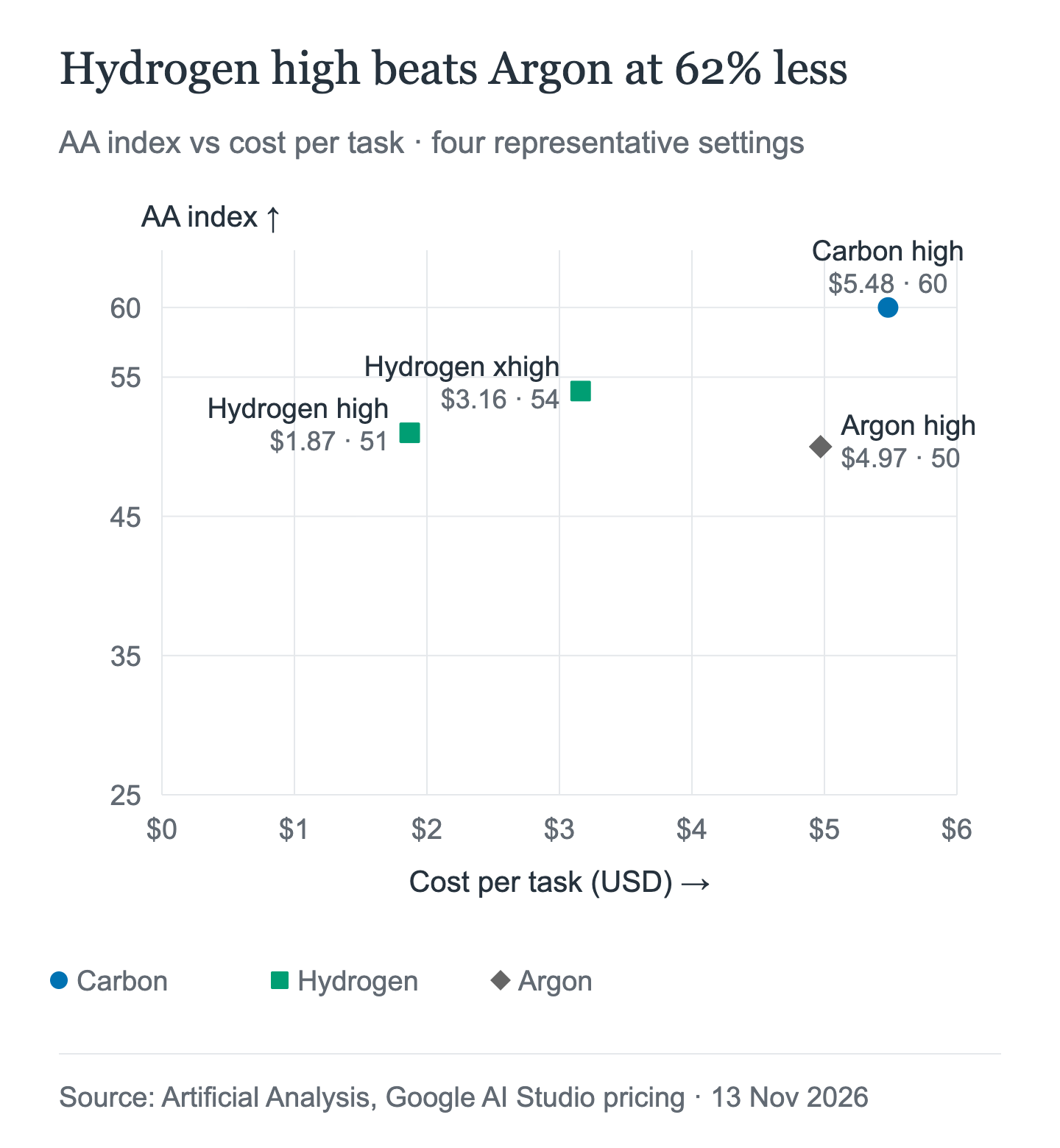
At its default high setting, Hydrogen scores 51 on Artificial Analysis's Intelligence Index at $1.87 per task and 8.3 minutes. Argon high scores 50 at $4.97 and 30.6 minutes. Hydrogen is one point ahead for 62% less per task. Carbon high remains the ceiling at 60, but costs $5.48 per task and waits 63.37 seconds for the first answer token.
That is the whole decision in one paragraph: Carbon for the hardest work, Hydrogen for execution, Argon for the cases where its protocol coverage or long-horizon positioning matters. The rest of this post fills in the evidence and the exceptions.
Three models, one shape
All three — Carbon, Hydrogen and Argon — take a unified 1,048,576-token window that includes input, thinking and output. All three support long decode up to that window minus the input, use implicit caching only with a 4,096-token minimum, and, on Google's API, require no schema change when you swap the model ID.
The differences are in the defaults and the edges.
| Item | Carbon | Hydrogen | Argon |
|---|---|---|---|
| Per-hop output | 65,536 / 32,768 | 65,536 / 65,536 | 65,536 / 32,768 |
| AIHubMix input | all multimodal | all multimodal | all multimodal |
| AIHubMix protocols | all four | chat only | all four |
| Price to Nov 30 | $2 / $10 / $0.10 | 1.50 / 7.50 / 0.075 | $2 / $10 / $0.10 |
| Price from Dec 1 | $4 / $20 / $0.20 | unchanged | $4 / $20 / $0.20 |
Prices are USD per million input, output and cached input tokens. Per-hop output is the maximum output tokens per synchronous hop, streaming / non-streaming. On AIHubMix, all three list text, image, audio, video and PDF input; Carbon and Argon document Chat Completions, Responses, Anthropic Messages and native Gemini, while Hydrogen documents chat completions only. Hydrogen adds xhigh; Carbon and Argon stop at high and default to medium. Sources: Google's model pages and pricing page; AIHubMix's model pages and model index.
Google's own job descriptions
Google does not present these as three sizes of the same thing. In the Gemini 4 Hydrogen release notes, the company describes Carbon as "our strongest frontier model," built for work that spends more thinking tokens on hard architecture, debugging, science and security problems. Argon can "handle the majority of advanced long-horizon tasks with lower token use than Carbon." Hydrogen is "fast and efficient while handling complex agentic workflows," and is the recommended upgrade from Gemini 3.8 Flash.
The model card adds the distinction that matters for routing: Carbon and Argon are "built for deep, long-horizon reasoning," while Hydrogen is "built for rapid execution across diverse agentic workflows" and can run "as sub-agents orchestrated alongside frontier models."
That is a division of labour, not a ranking. The measurements below show where the division is real and where the cheaper model has caught up.
The measured trade
Artificial Analysis's live snapshot at 2026-11-13T02:40Z covers eight configurations. It is Intelligence Index v5.0.1 with 78 ranked models, at standard list prices. The costs are AA task costs, not AIHubMix bills.
| Model / effort | AA rank | AA Index | $/task | Min/task | First answer token |
|---|---|---|---|---|---|
| Carbon high | 4 | 60 | 5.48 | 28.1 | 63.37 s |
| Carbon medium | 6 | 58 | 4.68 | 24.3 | 21.82 s |
| Carbon low | 14 | 54 | 5.22 | 24.7 | 13.61 s |
| Hydrogen xhigh | 16 | 54 | 3.16 | 13.5 | 37.77 s |
| Hydrogen high | 21 | 51 | 1.87 | 8.3 | 18.89 s |
| Hydrogen medium | 39 | 41 | 0.80 | 3.7 | 11.80 s |
| Hydrogen low | 60 | 27 | 0.29 | 1.3 | 5.71 s |
| Argon high | 22 | 50 | 4.97 | 30.6 | 41.30 s |
Three comparisons do most of the work.
Carbon high against Hydrogen xhigh. Carbon is six index points ahead, costs $2.32 more per task (73.4% more), takes 28.1 minutes against 13.5, and waits 63.37 seconds for the first token against 37.77. Carbon buys the top of the range; Hydrogen buys most of it for less and faster. The compare page puts the two listings side by side.
Hydrogen high against Argon high. Hydrogen is one point ahead, costs $3.10 less per task (62.4% less), and finishes in 8.3 minutes against 30.6. It also waits less than half as long for the first token, 18.89 seconds against 41.30. On this text-heavy index, Argon high is dominated by a cheaper model; the compare page is the cost check.
Carbon high against Argon high. Carbon is ten points ahead for $0.51 more per task (10.3% more), and it finishes slightly faster, 28.1 minutes against 30.6, despite a slower first token. The extra thinking is doing real work per task, even though it costs more per turn.
Two anomalies are worth keeping in view. Carbon low matches Hydrogen xhigh's 54, but costs $5.22 per task against $3.16 and takes 24.7 minutes against 13.5; Carbon's low setting is not its budget seat. And Hydrogen medium and low fall sharply to 41 and 27, so the gap between Hydrogen and its siblings depends heavily on which level you run.
Where the money changes on December 1
Hydrogen's price is flat across the full context window: $1.50 input, $7.50 output and $0.075 cached input. Carbon and Argon are $2, $10 and $0.10 through November 30, then double to $4, $20 and $0.20 on December 1. Hydrogen has no announced change.
| Model | Input | Cached input | Output | When |
|---|---|---|---|---|
| Hydrogen | $1.50 | $0.075 | $7.50 | Now, flat across 1M |
| Carbon / Argon | $2.00 | $0.10 | $10.00 | Through 2026-11-30 |
| Carbon / Argon | $4.00 | $0.20 | $20.00 | From 2026-12-01 |
| Hydrogen Batch / Flex | $0.75 | $0.0375 | $3.75 | Now |
| Carbon / Argon Batch / Flex | $1.00 | $0.05 | $5.00 | Through 2026-11-30 |
| Carbon / Argon Batch / Flex | $2.00 | $0.10 | $10.00 | From 2026-12-01 |
Official prices in USD per million tokens. The current gap is 25% per token; after December 1 it becomes 62.5% for input and output. If Carbon and Argon double while Hydrogen holds, their AA task costs would also roughly double at the same token mix — about $10.96 for Carbon high and $9.94 for Argon high. That is a computed estimate, not an AA measurement and not an AIHubMix bill.
AIHubMix lists all three at Google's current prices. The free tier is Google's only; the gateway is a paid route.
Google's routing: Carbon plans, Hydrogen executes
Google's own recommendation is not to pick one. The release notes say: "Route planning turns to gemini-4-carbon and execution turns to gemini-4-hydrogen."
Antigravity's new Orchestrator implements that idea as a product. It uses "a dynamic, bidirectional approach between Carbon and Gemini 4 Hydrogen within the evolution of a single trajectory." Carbon explores dependencies, resolves ambiguity and plans; Hydrogen handles edits, package updates and tests; if Hydrogen gets stuck, work returns to Carbon to repair the plan. Google reports "near-Carbon task success rates" while, on average, consuming 24% less quota and completing 19% faster; the launch post labels the benchmark Terminal-Bench 4.0, while Antigravity's post says 4.1, so treat the version as unsettled.
That is a vendor claim for a vendor product, and Orchestrator is not available through AIHubMix. But the pattern is portable: use Carbon for the turns that decide what to do, and Hydrogen for the turns that do it. The measurements above support the split — Hydrogen high is fast and cheap enough to run many execution turns, and Carbon high is the one that buys the last six index points.
Which model for which job
| Job | Pick and why |
|---|---|
| High-volume text work | Hydrogen medium; $0.80 per task, 41 index |
| Agent execution, tool loops | Hydrogen high; 51 at $1.87, 8.3 minutes |
| Interactive coding, UI work | Hydrogen high; AA's medium is 41 |
| Hard debugging, architecture | Carbon high; 60 index, the ceiling |
| Image, audio, video, PDF | Any of the three; all list the same inputs |
| Responses / Anthropic clients | Carbon or Argon; both list four protocols |
| Free-tier prototyping | Hydrogen; the only one of the three |
| Long-horizon planning + execution | Carbon plus Hydrogen; Google's routing advice |
Two cautions on the table. "Hard debugging" is not a precise threshold; the honest test is whether Hydrogen high or xhigh passes your evaluation, not whether the task sounds hard. And the free tier is Google's, not AIHubMix's.
Where Argon still wins, and where Carbon still wins
Argon is not obsolete. On the text-heavy AA index, Hydrogen high beats it on quality, cost and time. But Argon keeps one thing Hydrogen does not have on AIHubMix: four protocol surfaces. Google also positions Argon for "the majority of advanced long-horizon tasks," which is a different workload from AA's fixed task suite. If your agent uses a Responses or Anthropic Messages client, or runs for hours across tools on long-horizon work, the AA row does not settle the choice.
Carbon is still the ceiling. Hydrogen xhigh gets within six index points, and it does so for 42% less per task. But six points at the top of the index is the part that decides whether a hard debugging or architecture task succeeds. Carbon high also finishes faster per task than Argon high (28.1 against 30.6 minutes), even though its first token arrives later.
Hydrogen is the new default for execution. It is the cheapest per token, the fastest per task at high, the only free-tier option, and the only one with xhigh. For execution loops with text output, it is the model to beat.
Caveats
- The AA figures are a single live snapshot (v5.0.1, 78 models, 2026-11-13T02:40Z). They drift; re-check before routing production traffic.
- AA task costs are measured at standard list prices, not AIHubMix bills.
- Vendor benchmarks are self-reported. Hydrogen's model card reports Terminal-Bench 4.1; Carbon's reports Terminal-Bench 4.0. Do not compare the two rows directly.
- AIHubMix's protocol coverage differs by model. All three list multimodal input; Hydrogen documents chat completions only.
- Hydrogen is a "short-term generally available (GA) release subject to a minimum 45-day retirement notice policy." Carbon and Argon have no listed shutdown date.
- No live tests were run for this post.
FAQ
Which Gemini 4 model is best?
There is no single best. Carbon has the highest quality (60 on AA), Hydrogen has the lowest cost per task and the fastest execution at high (51 at $1.87), and Argon keeps four protocol surfaces and Google's long-horizon positioning on AIHubMix.
Is Hydrogen better than Argon?
On Artificial Analysis's text-heavy index, yes at high: 51 against 50, at 62% lower cost per task. Argon still wins when you need a Responses or Anthropic Messages endpoint on AIHubMix, or long-horizon work where Google positions it.
Which one is cheapest?
Hydrogen is cheapest per token ($1.50/$7.50) and usually cheapest per task on AA. But Hydrogen medium and low are much weaker (41 and 27), so the cheapest setting is not automatically the cheapest good-enough setting.
Does AIHubMix serve all three?
Yes, all three are listed. All three list text, image, audio, video and PDF input; Carbon and Argon document four protocols, and Hydrogen documents chat completions only.
Can I mix them in one application?
Yes, on Google's API. The request schema does not change, so the model string is the switch; on AIHubMix, Hydrogen is documented on chat completions only. Google recommends sending planning turns to Carbon and execution turns to Hydrogen. Orchestrator automates that in Antigravity, not through AIHubMix.
What happens on December 1?
Carbon and Argon double from $2/$10 to $4/$20 per million input/output tokens. Hydrogen's price is unchanged, so the gap widens from 25% to 62.5%.
Which one should I use for coding?
Hydrogen high for execution and interactive work; Carbon high for hard debugging, architecture and security. Test Hydrogen xhigh before paying for Carbon on a task that is merely long, rather than hard.
Keep reading: the Gemini 4 Hydrogen series
- If you are deciding whether to leave Gemini 3.8 Flash, the first post covers the launch, the price change and the benchmark trade-offs: Gemini 4 Hydrogen vs Gemini 3.8 Flash: Is the Upgrade Worth It?.
- If you want the cost and latency of each thinking level before choosing one, the second post measures all four: Gemini 4 Hydrogen Thinking Levels: low, medium, high, xhigh.
Sources
- Google AI Studio, Gemini 4 Hydrogen: what's new
- Google, Gemini 4 Carbon model page
- Google, Gemini 4 Argon model page
- Google Antigravity, Gemini 4 Hydrogen and Orchestrator
- Artificial Analysis, Gemini 4 Hydrogen — live snapshot 2026-11-13T02:40Z, Intelligence Index v5.0.1