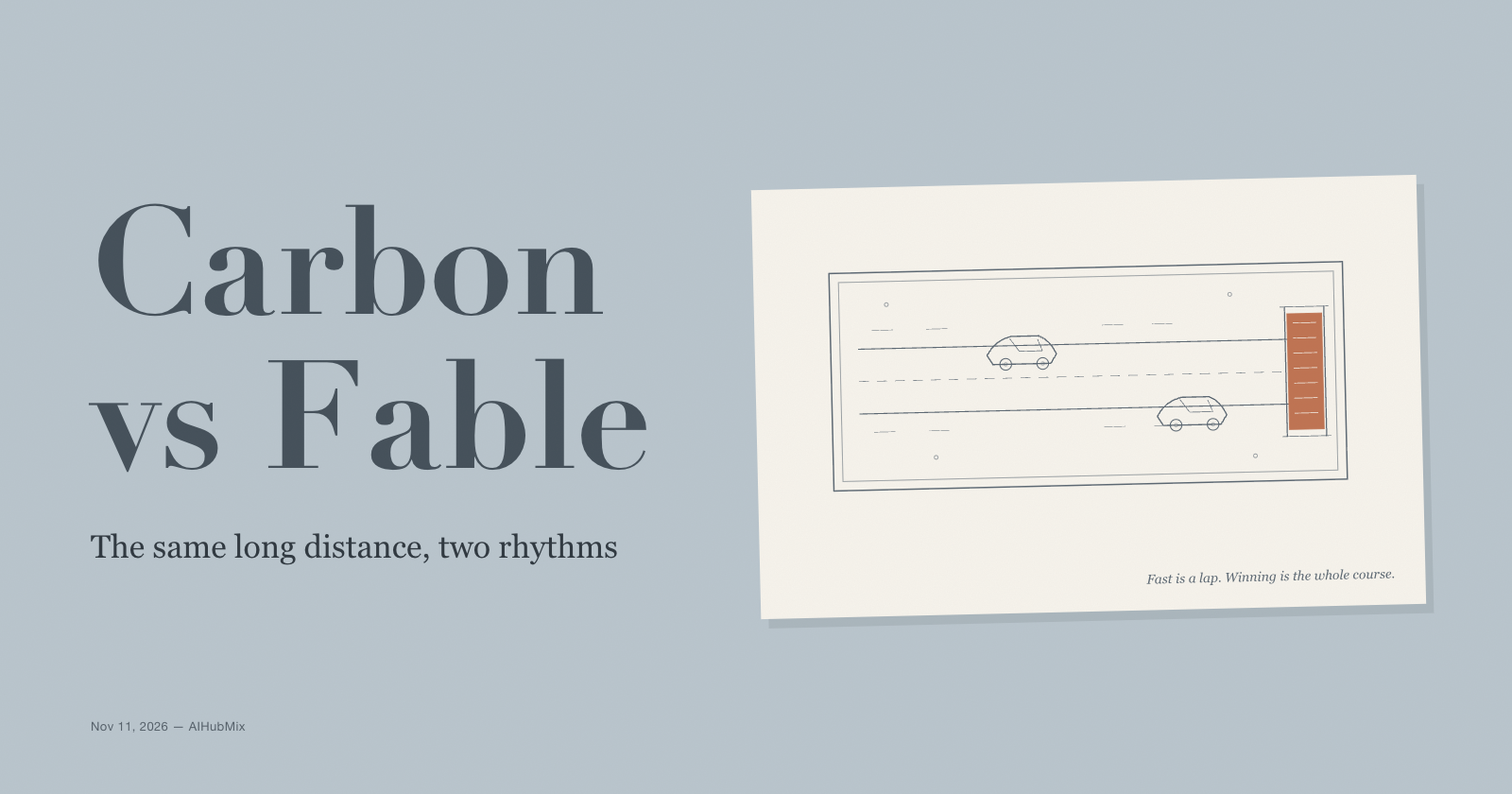
Anthropic released Claude Fable 5.2 on November 9, 2026. Google took Gemini 4 Carbon to general availability one day later. Anthropic's own launch benchmark table includes a Carbon column, which makes this a useful comparison for the same long-horizon coding workload.
Both models are sold for the same job: long-horizon agentic coding. The agent reads a repository, edits several files, runs commands, reads test output, and keeps going for 15 to 45 minutes without a human turn. That is the task scored here. Chat, autocomplete and short scripts are a different test.
The short answer
Fable 5.2 leads the listed hard-code benchmarks and is faster at equal effort, holding the top three AA places ahead of Carbon High at #4. Carbon scores higher on the listed Terminal-Bench 4.0 and AutomationBench-AA rows, and is cheaper per task at High effort until Google's introductory price ends on November 30. At Medium, Fable is cheaper and much faster, while Carbon scores higher on the AA index.
Pick Fable for hard code reasoning, Carbon for terminal execution and automation; check input, retention and output limits before either.
What one harness shows
Artificial Analysis runs every model on the same harness and tasks; its Carbon and Fable pages carry the per-eval results. Figures are from its November 11, 2026 snapshot; AA uses standard list prices, not Google's introductory discount.
| Model | AA index | $/task | Min/task | First token |
|---|---|---|---|---|
| Fable 5.2 Max | 64.56 | 26.54 | 45.2 | 233.9 s |
| Fable 5.2 Xhigh | 62.22 | 14.83 | 26.1 | 69.3 s |
| Fable 5.2 High | 61.82 | 9.08 | 17.3 | 30.4 s |
| Fable 5.2 Medium | 56.41 | 3.80 | 7.8 | 12.8 s |
| Carbon High | 60.03 | 7.76 | 25.6 | 67.1 s |
| Carbon Medium | 58.26 | 6.59 | 23.3 | 23.2 s |
| Opus 5.5 Max | 59.11 | 10.04 | 25.0 | 356.4 s |
Note: AA Intelligence Index and per-task cost at standard prices, snapshot 2026-11-11T05:23Z. Fable Max, Xhigh and High rank #1 to #3; Carbon High is #4; Opus 5.5 Max is #5; Carbon Medium is #6. First token is time to the first answer token.
At High effort Fable is 1.79 points ahead, costs 17.0% more per task ($9.08 vs $7.76), finishes in 17.3 minutes rather than 25.6, and returns its first token in 30.4 seconds rather than 67.1. Max costs $26.54 per task, 3.4 times Carbon High, and waits 233.9 seconds.
At Medium the order changes: Fable scores 56.41 against Carbon's 58.26, 1.85 points lower, but costs $3.80 against $6.59 and takes 7.8 minutes against 23.3. Carbon's lower token price does not make it cheaper per task here; it spends more tokens.
| Benchmark | Carbon High | Fable High | Fable Max | Opus 5.5 Max |
|---|---|---|---|---|
| Terminal-Bench 4.0 | 65.15 | 59.6 | 59.6 | 59.6 |
| FrontierCode 2.0 | 40.56 | 49.13 | 48.76 | 46.44 |
| AutomationBench-AA | 77.82 | 71.36 | 76.42 | 69.54 |
| HLE-Diamond | 69.1 | 73.8 | 80.2 | 67.9 |
| Non-halluc. % | 88.58 | 42.02 | 40.73 | 49.66 |
| Accuracy % | 58.27 | 77.23 | 79.13 | 65.5 |
| Briefcase Elo | 1610.6 | 1677.4 | 1785.3 | 1800.6 |
Note: Artificial Analysis, same harness and snapshot. Non-hallucination is the share of Omniscience answers with no fabricated claim; accuracy is a separate score. Higher is better on every row. Fable Xhigh is omitted to keep the table readable; its FrontierCode 2.0 score is 47.58.
Which model leads on each test at High effort? The signed gap below subtracts Fable from Carbon; it makes direction visible while the table above keeps the absolute scores.
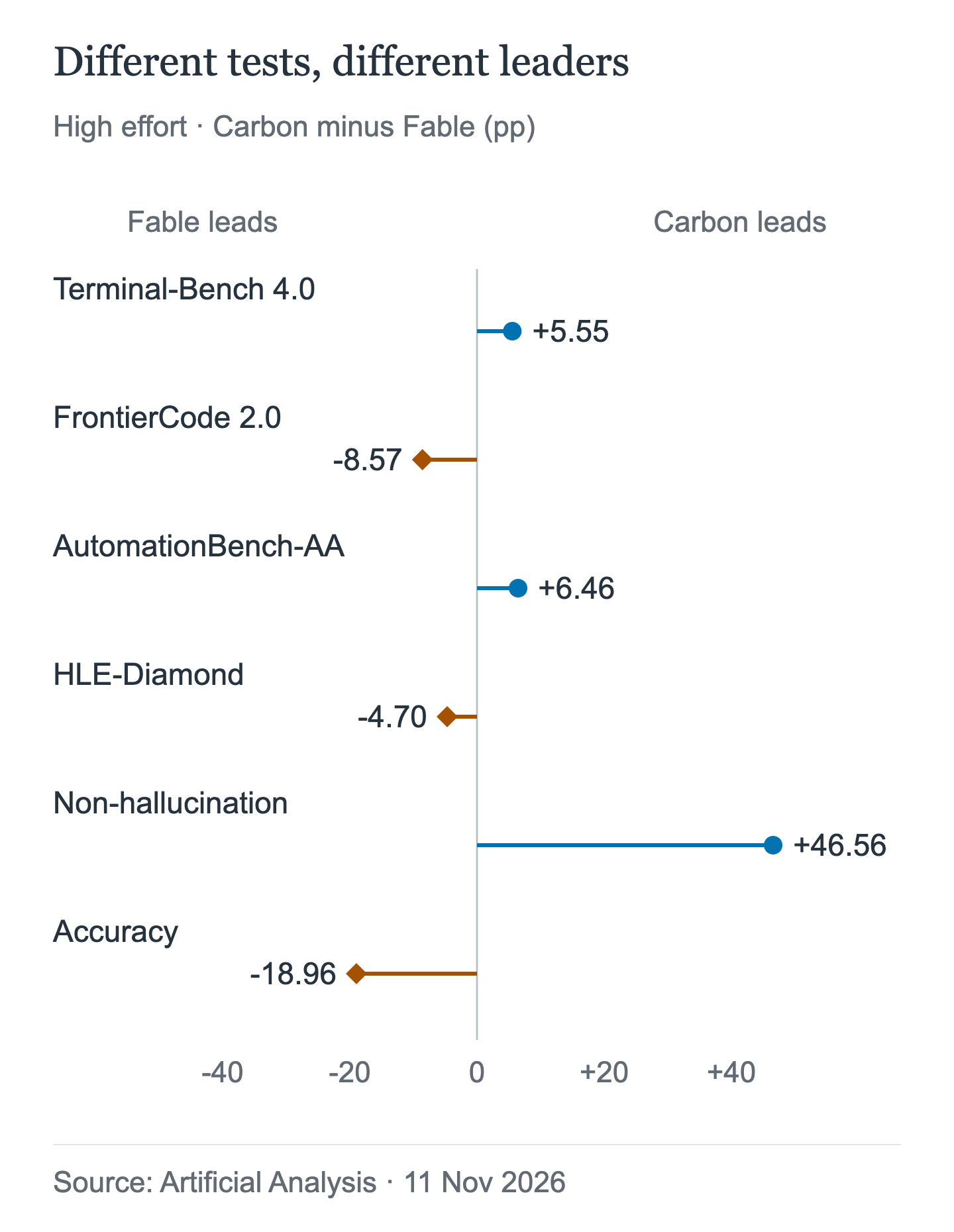
These are percentage-point gaps on independent tests, not a combined quality score. A larger gap on one benchmark does not mean a larger improvement in general ability. In particular, non-hallucination and accuracy measure different outcomes.
Fable wins FrontierCode 2.0 by 8.57 points at High and HLE-Diamond by 4.7; Briefcase Elo is 1677.4 against 1610.6. FrontierCode is the closest benchmark to difficult multi-file code changes. Carbon wins Terminal-Bench 4.0 by 5.55 and AutomationBench by 6.46, which reward command-line execution, recovery and automation.
The non-hallucination gap is the largest in the table: 88.58% for Carbon against 42.02% for Fable at High. Accuracy runs the other way, 58.27% against 77.23%. Carbon is less likely to fabricate and less likely to answer correctly. For an agent that must not invent an API, that can be worth it; for one that must answer, Fable's accuracy is the better signal.
More effort is not uniformly better: Fable Max's FrontierCode, 48.76, is slightly below High's 49.13, and Terminal-Bench stays at 59.6.
Anthropic's own table
Anthropic's launch page publishes a cross-vendor table with Carbon included. Its settings differ from AA's: Fable is run at Xhigh, its highest reported effort, and Carbon at Medium. Read this table only within itself.
| Benchmark | Fable 5.2 | Carbon |
|---|---|---|
| FrontierCode 2.0 | 49.1 | 41.1 |
| FrontierSWE v2 | 69.9 | 61.2 |
| AutomationBench | 51.4 | 53.9 |
| TB-Science 0.1 | 74.6 | 64.8 |
| OSWorld 2.1 | 89.3 | 81.5 |
| Briefcase Elo | 1785 | 1611 |
| Chartography | 73.4 | 72.5 |
Note: self-reported by Anthropic. Fable at Xhigh, its highest available effort; Carbon at Medium. Anthropic's AutomationBench scale differs from AA's (51.4/53.9 vs 71.36/77.82), so compare within this table. Carbon's 41.1 FrontierCode is a Medium run; AA's 40.56 is High on a different harness.
The direction matches AA: Fable leads FrontierCode, FrontierSWE, OSWorld and TB-Science; Carbon leads AutomationBench by 2.5 points, smaller than AA's 6.5 but the same sign. The table supports "Carbon is competitive on automation," not "Carbon is the better hard-code model."
Anthropic's own recommendation complicates "Fable is the upgrade": "For most coding and knowledge tasks, we recommend that users start with Claude Opus 5.5." At High effort, it says, Fable scores about the same as Opus 5.5's best (45.3% vs 45.5%) for roughly half the cost per task.
What the tokens cost
| Model | Input | Output | Cache read |
|---|---|---|---|
| Carbon, to Nov 30 | $2 | $10 | $0.10 |
| Carbon, from Dec 1 | $4 | $20 | $0.20 |
| Fable 5.2 | $8 | $40 | $0.20 |
| Opus 5.5 | $4 | $20 | $0.20 |
Note: USD per 1M tokens, official prices. Fable cache writes: $10 (5 min) or $16 (1 hour); Batch 50% off. Carbon's cached figure is a read price; Opus 5.5's official cache-read price is $0.20.
Fable's token price is twice Carbon's standard rate and four times its introductory rate. The ratio is simple; the per-task bill is not. AA measured $7.76 for Carbon High at $4/$20 against $9.08 for Fable High, a 17.0% gap. At Google's $2/$10 rate the same usage costs about $3.88, a computed estimate. Until November 30, Fable High costs about 2.3 times as much per task; from December 1 the gap returns to 17.0%.
At standard prices Fable Medium costs $3.80 against Carbon's $6.59, 42% less despite a token price twice as high. Carbon takes 23.3 minutes and spends more tokens; Fable takes 7.8. At the introductory rate Carbon Medium is roughly $3.30, computed the same way, close to Fable; that advantage disappears on December 1.
Max is 3.4 times Carbon High per task ($26.54) and takes 45.2 minutes. More spend does not buy a uniformly better coding agent: Max's FrontierCode is slightly below High's.
AIHubMix lists Carbon at Google's introductory price. Fable figures here are Anthropic's official rates.
Behaviour differences that decide deployments
| Dimension | Carbon | Fable 5.2 |
|---|---|---|
| Max output | 65,536; native ≤1,048,576−input* | 128,000 |
| Context | 1,048,576 (Google native) | 1M |
| Thinking | low / medium / high; default medium | adaptive; default high |
| Forced tools | auto documented* | any / tool returns 400 |
| Sampling | ignored; remove | some values return 400 |
| Retention | not stated as a limit | 30 days; no ZDR |
| Input | text on AIHubMix | text, image, PDF† |
| Cutoff | March 2026 | June 2026 |
Note: *Carbon higher ceilings are Google-native long-decode capabilities; AIHubMix currently documents only text input and Chat Completions, so gateway support is unconfirmed. †Fable input modalities come from the AIHubMix model index. *AIHubMix documents tool_choice="auto", but Carbon-specific support is unconfirmed. Fable's 128,000 output is its documented model limit. ZDR is zero data retention.
Forced tool use is a hard blocker on Fable: "Forced tool use (tool_choice types any and tool) returns a 400 error." An agent that must call a specific tool every turn cannot use Fable unchanged. Google's Carbon guide recommends sequential tool-execution turns; AIHubMix documents tool_choice="auto" in its Gemini guide, but Carbon-specific tool support on the gateway remains unconfirmed.
Retention is a policy blocker on Fable, whose overview says it "requires 30-day data retention and isn't available under zero data retention unless expressly authorized by Anthropic." Carbon's documentation, as read here, states no such constraint; that is not a guarantee. Regulated teams should confirm both policies before deployment.
Carbon's standard 65,536-token ceiling covers most edits; whole-file generation can hit it. Google-native background mode can reach up to 1,048,576 minus input, bills segment hops, and can return incomplete with empty text while still being billed. AIHubMix has not documented that path. Fable's 128,000 arrives in one response.
Neither model can disable thinking. Carbon offers low, medium and high, defaults to medium, and ignores sampling parameters. Fable's "adaptive thinking is always on and can't be turned off," defaults to high, and returns 400 for some sampling values.
Google released Carbon to defenders through its Fairwind program before GA. Fable's classifiers block pentest and exploit requests and fall back to other models for cyber and biology work. For security testing, refusal behaviour matters more than a benchmark row.
Opus 5.5 as the reference column
Opus 5.5 is not the rival, but it is Anthropic's own reference. At $4/$20 it scores 59.11 on AA, costs $10.04 per task, takes 25.0 minutes and waits 356.4 seconds for its first token, the slowest in the table (the AA row is Max effort; the default is medium). It wins Briefcase Elo at 1800.6 but trails Fable High on FrontierCode and Carbon High on Terminal-Bench. Anthropic still recommends Opus 5.5 as the starting point for most coding.
Who should pick which
Pick Fable 5.2 when hard code changes dominate and you want the best measured FrontierCode and HLE results. At Medium it is cheaper and faster—$3.80 and 7.8 minutes against Carbon's $6.59 and 23.3—while Carbon scores higher on the AA index. Choose it for image input, a June 2026 cutoff, or if 30-day retention and no forced tool calls are acceptable.
Pick Carbon when terminal work dominates: test-fix loops, shell automation, multi-step operations. It scores higher on the listed Terminal-Bench 4.0 and AutomationBench-AA rows and is cheaper at High effort until November 30. Its Google-native context and long-output ceilings are not confirmed through AIHubMix; deploy it text-only with tool_choice="auto" only after confirming Carbon tool support. Its non-hallucination score is higher, while its accuracy is lower.
Pick Opus 5.5 for Anthropic's recommended starting point and a balanced profile; accept the slow Max-effort first token.
Pick neither for interactive latency: High-effort first tokens are 30.4 seconds on Fable and 67.1 on Carbon, and Carbon Medium's 23.2 is still far from chat speed.
Run both through AIHubMix
AIHubMix exposes both models behind one key and a shared chat-completions endpoint. Carbon's ID is gemini-4-carbon; the model page documents chat completions, text input and Google's introductory price. Fable 5.2's ID is claude-fable-5-2; AIHubMix lists Chat Completions, Responses and Anthropic Messages, with 1M context and 128K max output. Carbon's documented surface is narrower: chat completions, not the native Gemini API. The gateway also retries the next-best provider, so behaviour can differ from a single-provider deployment.
The quick start covers authentication and the base URL. A smoke test can check whether both IDs resolve through the same key; no live test was run for this draft:
import os
from openai import OpenAI

client = OpenAI(
    base_url="https://aihubmix.com/v1",
    api_key=os.environ["AIHUBMIX_API_KEY"],
)

for model in ("gemini-4-carbon", "claude-fable-5-2"):
    response = client.chat.completions.create(
        model=model,
        messages=[{"role": "user", "content": "Reply with OK."}],
        max_tokens=4096,
    )
    print(model, response.choices[0].message.content)
This checks routing, not capability: no tools and no long output. For a real comparison, run the same agent trace against both IDs and record task time, token use and failures. The compare page puts context, protocols and pricing side by side.
FAQ
Is Gemini 4 Carbon better than Fable 5.2 for agentic coding?
Neither wins every part of the job. Fable 5.2 leads FrontierCode 2.0 and the overall index at High effort; Carbon leads Terminal-Bench 4.0 and AutomationBench. Pick by the workload the agent actually runs.
Why is Fable 5.2 four times Carbon's price?
At official rates, Fable is $8/$40 per million tokens against Carbon's $2/$10 introductory price, so four times on input and output. Against Carbon's standard $4/$20 rate from December 1, it is twice.
Does Fable 5.2 really cost less per task at Medium?
At standard prices, yes: $3.80 against Carbon Medium's $6.59, and 7.8 minutes against 23.3. Carbon's introductory token price narrows the gap; the standard comparison is the durable one.
Can Fable 5.2 force a tool call?
No. Anthropic documents that tool_choice values any and tool return a 400 error. Agents that require a forced call need a different loop or a different model.
Is Carbon less likely to hallucinate than Fable 5.2?
On AA's Omniscience non-hallucination measure, yes: 88.58% against 42.02% at High. Its accuracy is lower, 58.27% against 77.23%, so it is also less likely to give the right answer.
Can both models run through AIHubMix with one key?
Yes. Use gemini-4-carbon and claude-fable-5-2 with the same key and base URL. AIHubMix documents chat completions for Carbon and chat completions, Responses and Messages for Fable.
Keep reading: the Gemini 4 Carbon series
- Before choosing a rival, settle the sibling question: Gemini 4 Carbon vs Argon: Same Price, When Is Carbon Worth It?
- Once Carbon is in the loop, the first 400s and timeouts are usually configuration, not the model: Gemini 4 Carbon API Migration: 400 Errors, Timeouts and Output Limits
Sources
- Gemini 4 Carbon now available — Google, November 10, 2026.
- Claude Fable 5.2 — Anthropic, November 9, 2026.
- Claude Fable 5.2 overview — Anthropic documentation.
- Gemini 4 Carbon and Claude Fable 5.2 — Artificial Analysis, snapshot November 11, 2026.
- Gemini 4 Carbon on AIHubMix — model page and pricing.