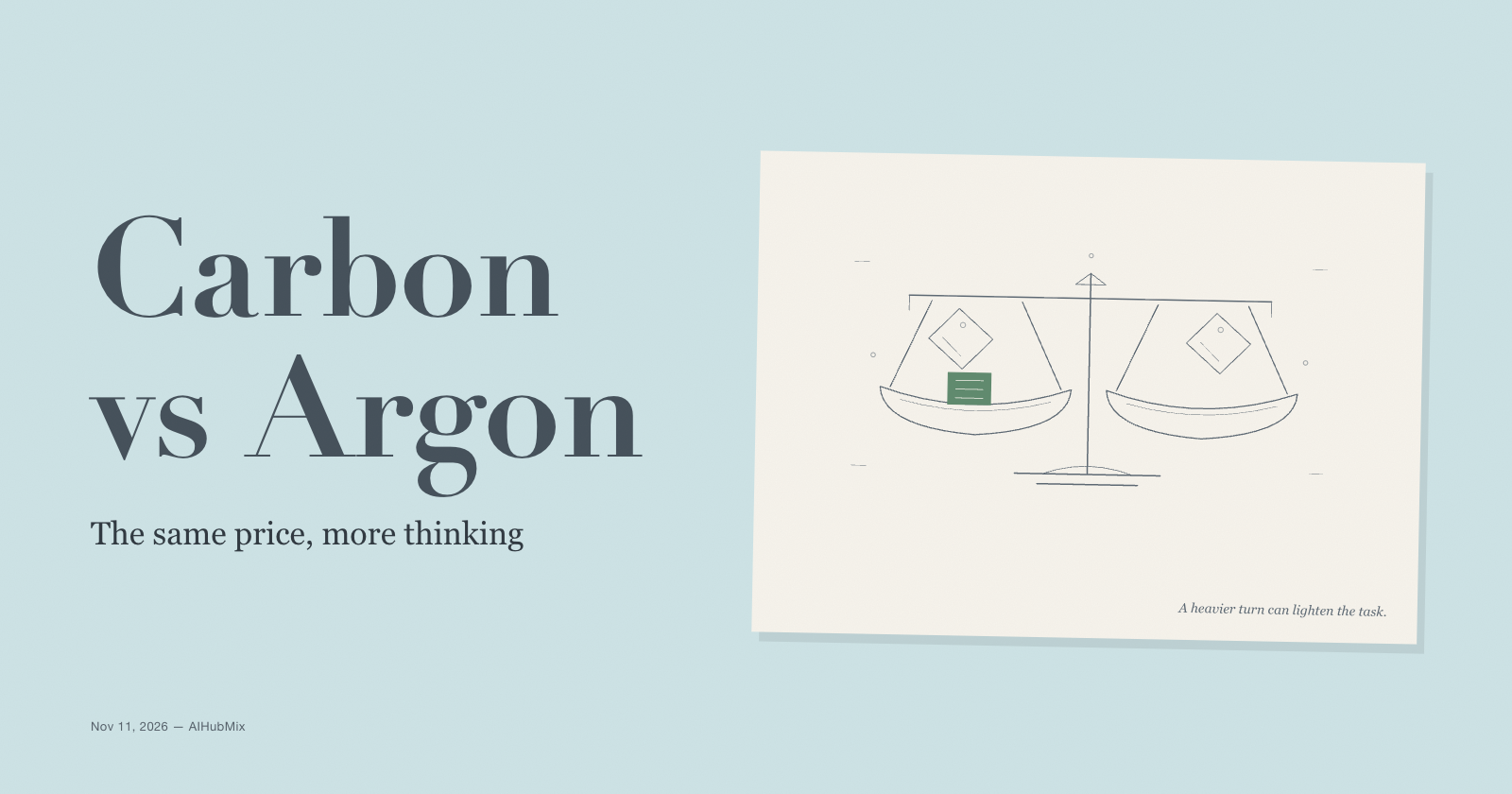
Gemini 4 Carbon is not a new model family. It is Gemini 4 Argon with more thinking per turn, sold at the same per-token price: $2 per million input tokens and $10 per million output tokens on introductory rates through November 30, 2026, then $4 and $20 from December 1. The question is not which model is cheaper per token. They are identical. The question is whether the extra thinking buys enough per completed task to justify a slower first response.
Artificial Analysis's live numbers give a clear answer for one kind of work and a clear warning for another. Carbon High ranks #4 of 104 on the AA Intelligence Index at 60.03, against 50.41 for Argon High. It costs $7.76 per task against $9.95, and finishes in 25.6 minutes against 29.0. But its time to first answer token is 67.1 seconds, against 40.1 for Argon. Carbon is the better model for a queue. Argon is the better model for a conversation.
That split is the whole post. Below: what changed, what the measurements say, what Google's model card adds, how the price moves on December 1, and which workloads should stay on Argon.
What changed from Argon
Google's model card states the relationship plainly: "Gemini 4 Carbon is based on Gemini 4 Argon." The model ID is gemini-4-carbon, the same on AIHubMix. Google documents a 1,048,576-token context window. Thinking levels are low, medium and high, with medium as the default. Standard output is 65,536 tokens; Google's native long-decode path can reach up to 1,048,576 tokens minus the input, with 131,072 and 262,144 as examples. AIHubMix currently documents Chat Completions only, so keep gateway requests at or below 65,536 until a larger path is documented. Knowledge cutoff is March 2026. Google does not offer the model on the free tier.
The change is described in Google's AI Studio notes: "Carbon spends more thinking tokens per turn to explore thoroughly and verify its work, which increases per-turn token use and latency compared to Argon." That sentence explains almost every difference later in this post. More thinking raises the ceiling on hard tasks, raises the per-turn bill, and raises the wait before the first token.
Migration is deliberately boring. "Upgrading from Argon requires no request schema changes." A model-string swap is enough at the API level. Google's operational advice is to "keep thinking_level at medium (default) unless a workload needs high, and make sure your max_output_tokens and HTTP timeouts allow for longer reasoning passes."
The measured trade: more thinking, less money per task
The figures below are Artificial Analysis's live measurements, accessed at 2026-11-11T05:23Z (model pages rechecked 06:01Z, unchanged), at standard prices of $4 per million input tokens and $20 per million output tokens.
The useful comparison is quality against completed-task cost: does Carbon move toward a higher index at a lower bill? The plot keeps the four model configurations separate.
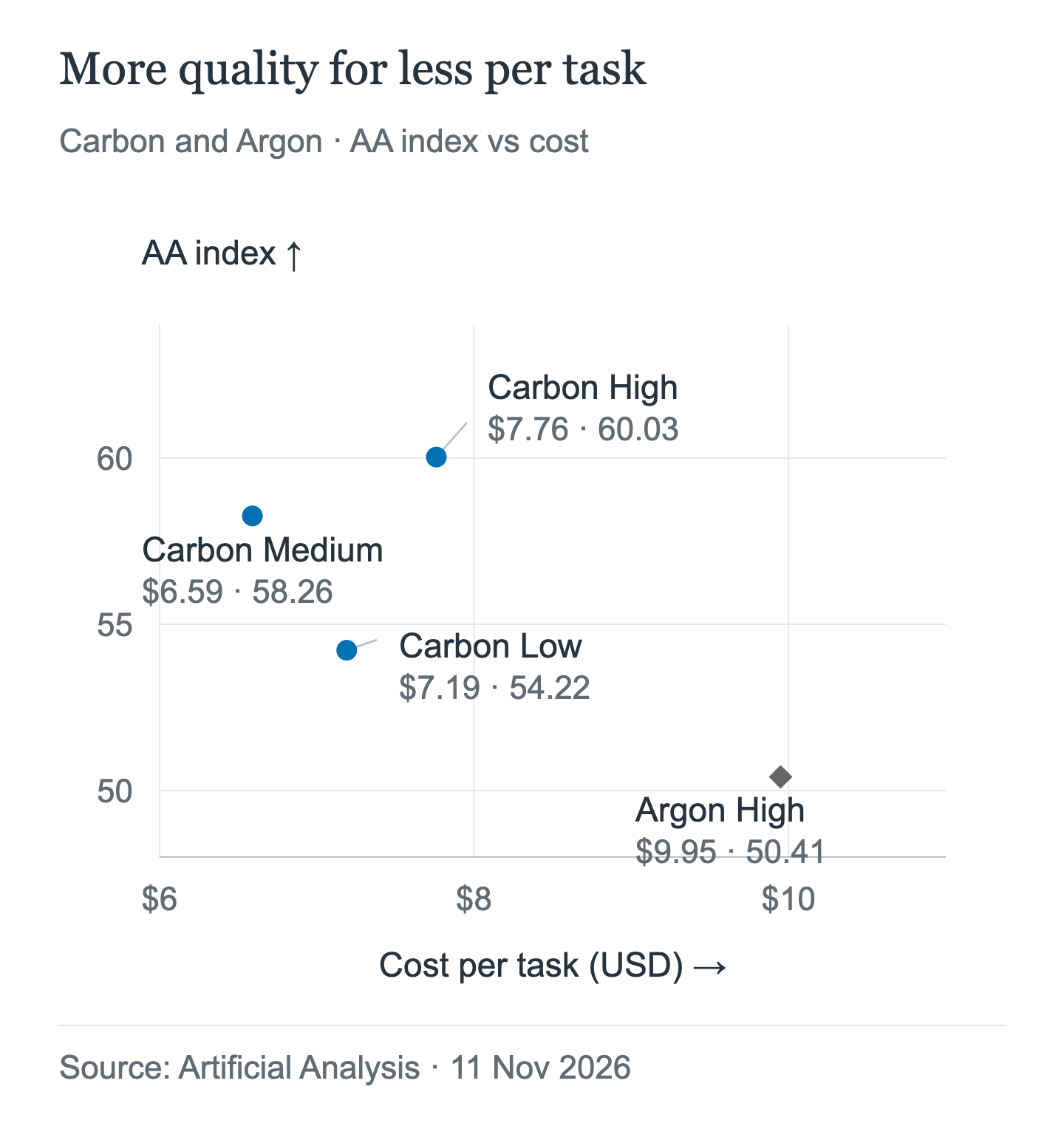
Carbon High sits above and to the left of Argon High. Medium is the cheapest Carbon setting in this run; Low is a latency choice, not the lowest-cost choice. These are AA task costs at standard prices, not AIHubMix request bills.
| Model | AA Index | $/task | Min/task | First token | Output tok/s |
|---|---|---|---|---|---|
| Carbon High | 60.03 | 7.76 | 25.6 | 67.1 s | 80.1 |
| Carbon Medium | 58.26 | 6.59 | 23.3 | 23.2 s | 73.7 |
| Carbon Low | 54.22 | 7.19 | 22.6 | 12.9 s | 63.5 |
| Argon High | 50.41 | 9.95 | 29.0 | 40.1 s | 66.8 |
Ranks are #4, #6 and #14 of 104 for Carbon High, Medium and Low; Argon High sits below them. The three entries above Carbon High are all Claude Fable 5.2 configurations. "First token" is time to first answer token. Carbon High versus Argon High: +9.62 index points, 22.0% cheaper per task, 25.6 versus 29.0 minutes, but 67.1 versus 40.1 seconds to the first answer token.
The index gap is large enough to change a leaderboard position. The latency gap is large enough to change whether a person waits. Both statements come from the same row.
Artificial Analysis calls Carbon "notably slow per task and very verbose" and reports that it generated 205 million tokens to run the index, against 113 million for Argon and a median of 72.8 million across the models measured. In this AA run, the per-task cost is lower alongside much higher output volume: the same list price, many more tokens, and a lower aggregate task cost.
One anomaly deserves a line of its own. Carbon Low costs $7.19 per task, more than Medium at $6.59, despite doing less thinking. Whatever the cause, Low behaves as a latency setting rather than a discount setting, so measure per-task cost before routing volume to it.
The coding-agent view
The Intelligence Index averages many tasks. The Coding Agent Index v2 is closer to what an API customer runs: a coding agent with tools, measured end to end on the same harness. Carbon High ranks #4; Argon High ranks #11.
| Rank | Agent + model | Index | $/task | Min/task | Cache hit |
|---|---|---|---|---|---|
| 4 | Antigravity CLI + Carbon High | 59.4 | 7.74 | 29.8 | 0.95 |
| 11 | Antigravity CLI + Argon High | 53.2 | 11.73 | 34.7 | 0.87 |
Same agent, same harness, different model, so the comparison isolates the model rather than the scaffolding. Carbon is 34.0% cheaper per task, +6.2 index points, 4.9 minutes faster, and produces almost the same output per task: 109,031 tokens against 109,236. Its cache hit rate is higher, 0.95 against 0.87, and its input use is lower, 12.44 million tokens against 13.76 million.
Two cautions. Carbon is #4 on this index: Claude Code with Opus 5.5 Max leads at 61.7, followed by Devin Fusion CLI and GitHub Copilot Fusion. And Fable 5.2 is not on the index at all, so this table cannot settle the Carbon-versus-Fable question.
What Google's model card adds, and what it does not
Google's model card is a vendor document: results as of October 2026, self-reported, and a different snapshot from the live data above. On the rows below, Google's Carbon number is higher every time.
| Benchmark | Carbon | Argon |
|---|---|---|
| AA Index v5.0 (vendor) | 59 | 50 |
| Terminal-Bench 4.0 | 65.2 | 57.1 |
| FrontierSWE 2 | 61.2 | 55.0 |
| OSWorld-2.1 | 81.5 | 74.7 |
| Agents' Last Exam | 77.4 | 69.0 |
The AA row is Google's rounded 59, not the live 60.03 in the earlier table; the two figures come from different snapshots and should not be mixed. The card's external comparison is Fable 5.1, not Fable 5.2.
The consistency is the useful part: the gain is not one benchmark. The limit is also visible. A vendor card does not price a task, measure first-token latency, or tell you how many turns your agent will take. It supports "Carbon is the stronger model on average." It does not support "Carbon is the better model for your loop."
Price: the same rate card, with the same December 1 change
Carbon and Argon match line for line. Both are on introductory rates until November 30, 2026, and both double on December 1.
| Model | Input | Output | Cached read |
|---|---|---|---|
| Carbon, intro (to Nov 30) | $2.00 | $10.00 | $0.10 |
| Carbon, from Dec 1 | $4.00 | $20.00 | $0.20 |
| Argon, intro (to Nov 30) | $2.00 | $10.00 | $0.10 |
| Argon, from Dec 1 | $4.00 | $20.00 | $0.20 |
| Gemini 3.1 Pro Preview (≤200k) | $2.00 | $12.00 | $0.20 |
| Fable 5.2 | $8.00 | $40.00 | $0.20 |
Official prices in USD per million tokens, November 11, 2026. Gemini 3.1 Pro Preview is $4/$18/$0.40 above 200k prompt tokens, plus $4.50 per million tokens per hour of storage. Fable 5.2 cache writes are $10 for five minutes or $16 for one hour; batch is 50% off. Carbon and Argon introductory rates end November 30; every Carbon and Argon rate doubles on December 1.
AIHubMix lists Carbon at $2/$10/$0.10, matching Google's introductory rates. This post does not assume what the gateway charges after November 30; check the model page for the current figure.
Repricing Artificial Analysis's measured token counts at the introductory rates gives rough per-task estimates of $3.88 for Carbon High, $3.30 for Medium, $3.60 for Low and $4.98 for Argon High. Those are computed estimates, not AA measurements: the calculation holds each task's token mix constant, and your prompts and cache hit rate will move the result.
Per token, Fable 5.2 costs twice as much as Carbon at standard rates and four times as much at the introductory rates. That is a price gap, not a quality verdict; the series' third post covers the comparison.
Where Carbon is not the better choice
The case against Carbon is not that it is worse. It is that the thing it buys, more thinking per turn, is the thing an interactive product cannot spend.
The first token arrives late. Carbon High waits 67.1 seconds before its first answer token; Argon High waits 40.1. Medium cuts the wait to 23.2 seconds and Low to 12.9, but both give back index points. A chat interface that pauses for a minute has already lost the turn, whatever the answer looks like when it lands.
Google says to keep Argon for speed. Argon is positioned for "faster responses and lower token spend per turn" on "interactive coding, day-to-day feature work, and fast production loops." The instruction in the migration notes is blunt: "Keep Argon where speed matters." Google's announcement post repeats the point: "Argon remains the ideal choice for the majority of software engineering and knowledge work."
Per-turn spend is higher even when per-task cost is lower. The price per token is the same, but Carbon uses more thinking tokens per turn. A team watching token spend per turn, or rationing a token quota, experiences Carbon as the more expensive model. The 205-million-token index run against Argon's 113 million is the extreme version of that effect.
Low is not the cheap seat. At $7.19 per task, Carbon Low costs more than Medium at $6.59. If cost per completed task is the routing rule, Low fails it.
Benchmark wins do not buy back the clock. OSWorld-2.1 and FrontierSWE 2 both favor Carbon in Google's table, but those are vendor-reported, and neither changes the first-token wait. Benchmarks measure the end state; users experience the start.
Who should switch now, who should stay on Argon
Switch to Carbon now if you run vendor-native batch or background agent jobs (those paths are not documented for Carbon on AIHubMix), if a quality failure costs more than wall-clock time, if your requests can tolerate longer timeouts and a larger output budget, or if you are already paying for retries that Carbon might avoid.
Stay on Argon if you build chat, autocomplete, or any loop with a human waiting; if your budget or quota is measured per turn; or if a latency target under about 30 seconds is part of the product.
Test first if you are in between. Send the same 20 to 50 real requests through both models, record first-token time and cost per completed task, and route by that rather than by the index. The AIHubMix compare page puts the two model pages side by side.
How to call it through AIHubMix
Carbon uses the same model ID pattern on AIHubMix and the documented chat-completions endpoint.
import os
from openai import OpenAI

client = OpenAI(
    base_url="https://aihubmix.com/v1",
    api_key=os.environ["AIHUBMIX_API_KEY"],
)

response = client.chat.completions.create(
    model="gemini-4-carbon",
    messages=[{"role": "user", "content": "Summarise this incident report and list the follow-ups."}],
    max_tokens=16384,
)

print(response.choices[0].message.content)
The endpoint is POST /v1/chat/completions; that is the only route AIHubMix documents for this model. Text is the listed input modality. Image and PDF input, the Responses API, Anthropic Messages, and the native Gemini endpoint are not documented for Carbon on AIHubMix, so treat them as unconfirmed. The same applies to reasoning_effort mapping: do not assume the gateway passes a thinking-level parameter through. Keep max_tokens within the 65,536 standard output limit; the larger limits require Google's background mode and are not confirmed on AIHubMix. No live test was run for this post, so the sample shows the request shape rather than a verified response.
FAQ
Is Carbon the same price as Argon?
Yes. Google's official rates are identical: $2 per million input tokens and $10 per million output tokens through November 30, 2026, then $4 and $20. Cached reads are $0.10 and then $0.20.
Is Carbon better than Argon?
On quality and cost per completed task, yes in Artificial Analysis's measurements: 60.03 versus 50.41 on the Intelligence Index and $7.76 versus $9.95 per task. On responsiveness, no: its first answer token takes 67.1 seconds against 40.1.
Why is Carbon slower if it finishes tasks faster?
It waits longer before answering, then completes the whole task sooner: 25.6 minutes against 29.0. The first-token wait and the total task time are different measurements, and they point in opposite directions.
Do the requests need to change?
No. Google says upgrading from Argon requires no schema changes; the model string becomes gemini-4-carbon. Raise the output limit and HTTP timeout to cover longer thinking.
Why does Carbon Low cost more per task than Medium?
Artificial Analysis measured $7.19 for Low against $6.59 for Medium. Treat Low as a latency setting, not a discount setting, and measure per-task cost before sending volume through it.
Where does Carbon rank on Artificial Analysis?
It is #4 on the Intelligence Index, behind three Claude Fable 5.2 configurations. Google's model card shows a rounded 59 for the same index; the live figure is 60.03, and the two should not be mixed.
Is Carbon available on the free tier?
No. Google does not offer Gemini 4 Carbon on the free tier, so access is through paid API pricing or a gateway such as AIHubMix.
Keep reading: the Gemini 4 Carbon series
- If this post convinced you to try Carbon but your first request failed, the migration guide covers the 400 errors, timeout settings, and output limits that change with longer thinking passes: Gemini 4 Carbon API Migration: 400 Errors, Timeouts and Output Limits.
- If the open question is whether Carbon is enough model for agentic coding, or whether Fable 5.2's premium buys anything, the third post sets the same measured numbers beside Fable 5.2: Gemini 4 Carbon vs Fable 5.2: Which One for Agentic Coding?.
Sources
- Google AI Studio, Gemini 4 Carbon: what's new
- Google DeepMind, Gemini 4 Carbon model card
- Google AI Studio, Gemini API pricing
- Artificial Analysis, Gemini 4 Carbon
- AIHubMix, Gemini 4 Carbon