Last updated: November 5, 2026. The AI model market changes every few weeks, so this guide is built to be revised. It separates the three leaderboards, records list prices, and gives a decision table you can re-run when the next model ships.
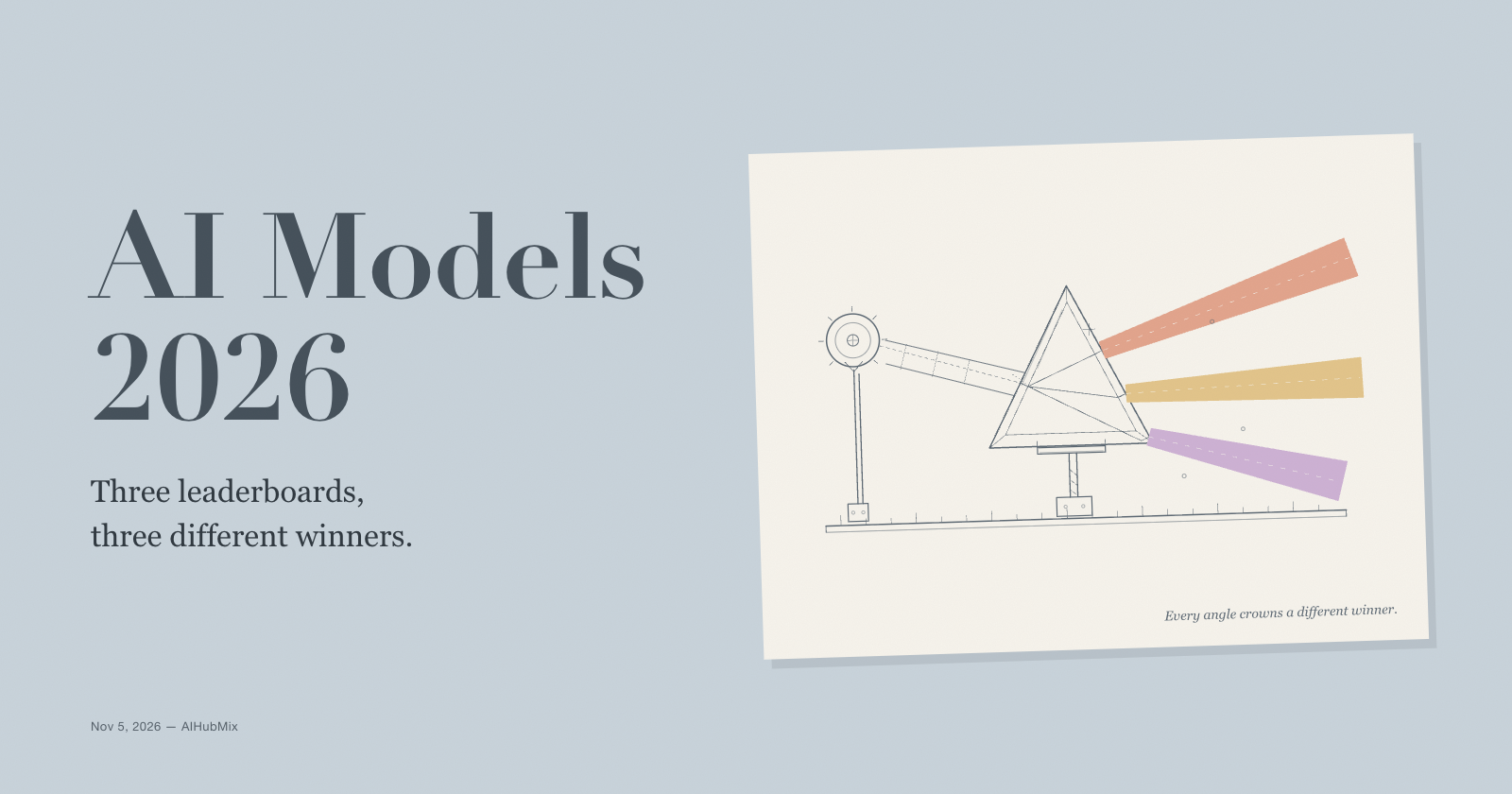
Right now, "the strongest AI model" has three different answers, and they are not interchangeable.
Gemini 4 Carbon tops the Artificial Analysis Intelligence Index at 60, but Google has released it only to a subset of cyber defenders and partners in its Fairwind program. Claude Opus 5.5 sits one point behind and leads the Arena Agents leaderboard, and any developer can call it today. GPT-6.1 Sol sits five points behind Carbon and four behind Opus, yet it costs $1.27 per task on Artificial Analysis's measurement, roughly an eighth of Opus's $10.04.
That is the shape of the market now: intelligence, availability, and cost per task have become three separate leaderboards. This post separates them, then gives a decision table for the models that matter.
Three leaderboards, three different winners
The Artificial Analysis Intelligence Index is a composite score built from reasoning, coding, knowledge, and agentic evaluations. The current board puts Carbon at 60, Opus 5.5 at 59, GPT-6 Astra at 57, and a cluster at 55 that includes Claude Sonnet 5.5 and GPT-6.1 Sol. Google's launch post cited 59 for Carbon on an earlier v5.0 snapshot; the current leaderboard shows 60. That one-point difference is a version change, not a new model.
The Arena Agents leaderboard measures something else: how often people prefer a model's output on agent tasks. Opus 5.5 ranks first at 20.14%, Carbon second at 16.72%, Sonnet 5.5 third at 15.42%, and Astra fourth at 14.70%.
Cost per task is the third axis. Artificial Analysis runs each model through the same evaluation and records what the run cost, including reasoning and output tokens. On that measure, Terra comes in at $0.96, Sol at $1.27, Astra at $6.24, Carbon at $7.76, Sonnet at $10.02, and Opus at $10.04.
A model can win one board and lose another. Carbon wins intelligence and is second on Arena, but most teams cannot use it. Opus wins Arena and is second on intelligence. Sol wins cost among models that score 55 or better.
The first tier at a glance
| Model | AA II | Arena Agents | List price (in / out) | Best for |
|---|---|---|---|---|
| Gemini 4 Carbon | 60 | #2 | $4 / $20 | Security research |
| Claude Opus 5.5 | 59 | #1 | $4 / $20 | Complex agents |
| GPT-6 Astra | 57 | #4 | $10 / $50 | Computer use |
| Claude Sonnet 5.5 | 55 | #3 | $2 / $10 | Precise coding |
| GPT-6.1 Sol | 55 | #6 | $2 / $10 | High-volume agents |
| GPT-6.1 Terra | 51 | #7 | $1 / $5 | Value and vision |
| Gemini 4 Argon | 50 | #8 | $4 / $20 | Multimodal research |
Prices are per million tokens. Carbon is $2/$10 during its launch period and $4/$20 at standard rates. Argon is $2/$10 through November 30, 2026, then $4/$20. Carbon is not in AIHubMix's catalog; the other six models in this table are available through AIHubMix. AA scores use each model's highest-scoring setting: max for Opus, Astra, Sonnet, Sol, and Terra; high for Carbon and Argon.
Two things stand out. The price spread inside the first tier is enormous: Terra's token price is a tenth of Astra's, and its cost per task is about 15% of Astra's. And the order is not stable across boards: Sonnet is third on Arena and fourth on the intelligence index; Astra is third on the index and fourth on Arena.
The practical reading is to pick the axis that matches your constraint. If you need the highest ceiling and have access, Carbon. If you need a model you can ship today, Opus. If you need volume, Sol or Terra.
What each flagship is actually for
Claude Opus 5.5: the production default
Claude Opus 5.5 is the model to beat for work that needs judgment across many steps. It scores 59 on the intelligence index at max effort, leads Arena Agents at 20.14%, and Anthropic reports 66.4% on Terminal-Bench 4.0 at xhigh effort, 1846 Elo on GDPval-AA v2.1, and 67.7% on Humanity's Last Exam with tools.
The economics improved at the same time. Opus 5.5 lists at $4/$20 per million tokens, and Anthropic says typical workloads cost about 40% less than they did on Opus 5. It supports a 1M-token context window and 128K output tokens. Artificial Analysis measures $10.04 per task and 26.2 minutes per task.
That last number matters. Opus is not a model for high-volume classification or draft generation. It is for long coding sessions, research that requires holding several documents together, and agents that must decide what to do next. If the output is valuable enough that a wrong answer costs more than ten dollars, Opus is the safer default.
Gemini 4 Carbon: the leader you probably cannot use
Gemini 4 Carbon is the intelligence leader. Google's launch post cites 59 on AA v5.0; the current leaderboard shows 60. It ranks second on Arena Agents at 16.72%, and Google reports 88.2% on SEC-bench Pro, 71.0% on CWE-bench, and 54.8% on ExploitGym. The launch price is $2/$10, with a standard price of $4/$20.
The catch is access. Carbon is available to a subset of cyber defenders first, then to additional trusted partners through the Fairwind program. Google says broader access is planned, but it is not generally available now. It is also not in AIHubMix's catalog. Google's launch post does not list a context window for Carbon.
For most teams, Carbon is a signal about where Gemini 4 is heading, not a model to plan around. The usable Gemini 4 is Argon.
GPT-6 Astra: the expensive specialist
GPT-6 Astra is OpenAI's strongest model for ambiguous, cross-application work. It scores 57 on the intelligence index at max effort, ranks fourth on Arena Agents at 14.70%, and lists at $10/$50 per million tokens with a 1.05M-token context window and 128K output. Above 272K input tokens, the higher rates apply to the full request: $20 input and $75 output. Artificial Analysis measures $6.24 per task and 18.8 minutes per task.
Astra's token price is five times Sol's, and its measured cost per task is about five times Sol's as well: $6.24 versus $1.27. Against Opus, the picture changes. Astra's token price is 2.5× Opus's, but its per-task cost is lower, because it spends fewer tokens per task. In OpenAI's own software-maintenance write-up, the Ultra effort configurations tell the same story: Astra spent $109.06 to produce 142 findings ($0.77 per finding), and Sol spent $15.12 to produce 131 findings ($0.12 per finding). That is 92% of the findings at 14% of the API cost.
Astra makes sense when the task is genuinely open-ended: cleaning up a large repository, operating a browser and several desktop apps, or tracing a problem across tools. It does not make sense for bulk generation, where Terra or Sol will do the same work for a fraction of the bill.
Claude Sonnet 5.5 vs GPT-6.1 Sol: same price, different bill
Sonnet 5.5 and Sol share a list price of $2/$10. They do not share a cost per task. Artificial Analysis measures $10.02 for Sonnet and $1.27 for Sol, a 7.9× gap, and 30.6 minutes versus 20.9 minutes per task.
The gap comes from how much each model writes and thinks. Anthropic positions Sonnet as a faster, lower-cost complement to Opus for well-scoped everyday tasks, bug fixing, and polished documents, and says Opus remains clearly stronger at complex, open-ended work that needs sustained judgment. Sonnet's vendor-reported Terminal-Bench 4.0 score of 70.6% is higher than Opus's 66.4%, but Sonnet's effort setting is not published, while Opus's figure is at xhigh. A benchmark measures a task, not judgment. The token economics still explain why Sonnet can cost as much per task as Opus despite a token price half as large.
Sol is the volume model. It scores 55 on the intelligence index at max effort, ranks sixth on Arena Agents at 12.51%, and supports the same 1.05M-token context window. For agent loops that run thousands of times a day, code maintenance, batch analysis, and first-pass review, Sol's $1.27 per task is the number that matters.
A simple rule: Sonnet when the output needs to be right and read by a person; Sol when the output needs to be checked by another model or a test suite.
Gemini 4 Argon: the usable Gemini 4
Gemini 4 Argon is the Gemini 4 model most teams can actually use. It scores 50 on the intelligence index at high effort and ranks eighth on Arena Agents at 10.53%. It takes text, images, audio, video, and PDFs, supports a 1M-token context window, and lists at $2/$10 through November 30, 2026, then $4/$20. Artificial Analysis measures $9.95 per task and 25.8 minutes per task.
Google's reported results are strongest on multimodal and scientific work: Vals Index first overall, 87% on ERQA, 57% on RareBench, and 52.2% on LabBench. It is the right model for long video, chart-heavy documents, 3D and spatial reasoning, and research that mixes formats. It is the wrong model for low-latency chat; AA measures 25.8 minutes per task, in the same range as Opus, so budget for asynchronous or batch use.
Kimi K3.1 Pro: the open-weight coding challenger
Kimi K3.1 Pro is the closest an open-weight model has come to the closed frontier on coding. Moonshot reports 65.7% on Terminal-Bench 4.0, 0.7 points behind Opus 5.5, plus 61.2% on Kimi Code Bench 3.0 Long-horizon, 92.7% on BenchCAD with tools, and 64.4 on OfficeQA Pro v2. It supports a 1,048,576-token context window and was released on October 24, 2026; the weights were published on Hugging Face on November 2 under the Kimi K3.1 Pro License.
The caveat is the intelligence index. AA puts Kimi at 46, 13 points below Opus. Its Arena Agents rank is outside the top ten. That combination says the model is excellent at the tasks its vendor chose to measure, and not yet a general replacement for a frontier flagship. Use it for terminal coding, CAD and 3D work, and financial documents where an open license or self-hosting matters.
Moonshot's pricing page did not show a USD list rate in the version we checked; AIHubMix lists Kimi K3.1 Pro at $2/$10.5 per million tokens. Artificial Analysis measures $3.68 per task.
Claude Haiku 5.5: the high-frequency option
Haiku 5.5 is the small-task model. It scores 36 on the intelligence index, lists at $0.10/$0.50 per million tokens for prompts up to 100K tokens ($0.50/$2.50 above that), and supports a 1M-token context window. Artificial Analysis measures $0.41 per task.
That is the right tool for classification, extraction, routing, summarization, and sub-agents that need to make a quick decision inside a larger workflow. It is not a model for hard reasoning; the gap to Opus is 23 index points. The practical pattern is to let an Opus or Sonnet agent plan, and let Haiku execute the cheap, well-specified steps.
Claude Fable 5.1: the other Anthropic flagship
Fable 5.1 is easy to miss because it is not the model most teams reach for. It lists at $10/$50 per million tokens, supports 1M tokens of context and 128K output, and is generally available. Anthropic calls Fable 5.1 and Mythos 5.1 its most advanced models for coding and knowledge work, though the page does not compare Fable directly with Opus 5.5. AA puts it at 49 at max effort and 50 at xhigh; Arena ranks it fifth at 13.86%.
Its restricted sibling, Mythos 5.1, is the same underlying model with more permissive safeguards for vetted US organizations working in cybersecurity and the life sciences, available only through Anthropic's trusted-access programs. Fable's token price is 2.5× Opus's, but the premium does not buy a higher index score: at xhigh, Fable scores 50 to Opus's 57; at max, 49 to 59. AA measures $10.85 per task for Fable at xhigh versus $10.04 for Opus at max, about 8% more. Test it before assuming the premium is worth it.
Open weights: close on coding, not on general intelligence
| Model | Size and license | Context | List price (in / out) | Why it matters |
|---|---|---|---|---|
| Kimi K3.1 Pro | 2.8T / 104B; Kimi license | 1M | Not published | Terminal-Bench 4.0 65.7% |
| GLM 5.3 | 753B MoE; glm-5.3 license | 1M | $1.40 / $4.40 | Terminal-Bench 4.0 41.9% (Max) |
| DeepSeek V4.1 Flash 1017 | 763B; MIT | 1M | from $0.15 / $0.60 | Vision plus 1M context |
| MiniMax M3.1 Flash | 428B / 23B active; community | 1M | ¥1 / ¥4 | OSWorld 2.0 61.7% |
Benchmark figures in the open-weight table are vendor-reported; GLM's Terminal-Bench 4.0 score is its Max configuration on the mini-swe-agent harness.
Kimi is the headline. A 65.7% Terminal-Bench score within 0.7 points of Opus is a real achievement, and the 1M context makes it usable for repository-scale work. But the intelligence index gap is the other half of the story: 46 versus 59. A model can be close on one coding benchmark and still be far behind on the mix of reasoning, knowledge, and agentic tasks that the index measures.
GLM 5.3 is the cost-oriented choice in this group. AA puts it at 32 at max effort, well below Kimi's 46, but it is a 753B MoE model under the glm-5.3 license with a vendor-reported 41.9% on Terminal-Bench 4.0 (Max, mini-swe-agent), 1769 Elo on GDPval-AA v2, and 62.5% on Humanity's Last Exam (HLE) with tools. The official price is $1.40/$4.40; AIHubMix currently lists it below list at $1.13/$3.94 per million tokens.
DeepSeek V4.1 Flash 1017 is the cost and ownership play. It is a 763B model under MIT, with a 1M-token context window, 384K max output, and vision input. The official price is $0.15/$0.60 off-peak and $0.30/$1.20 at peak; peak hours are 01:00–04:00 and 06:00–10:00 UTC, Monday through Friday, excluding Chinese public holidays. Cache-hit input costs $0.003 off-peak and $0.006 at peak per million tokens. It is not a first-tier generalist, but it is a very cheap way to own a long-context multimodal model.
MiniMax M3.1 Flash is the multimodal agent option: 428B total parameters, 23B active per token, a 1M-token context window, text/image/video input, and an OSWorld 2.0 score of 61.7. MiniMax prices it in CNY at ¥1/¥4 per million tokens. It is a credible self-hosted alternative for computer-use workflows, though its speed is unremarkable.
The value of open weights is not that the gap has closed everywhere. It is that you can own the model when data cannot leave your network, when costs must be fixed, or when you need to fine-tune. On those constraints, a few index points matter less than deployment freedom.
Outside the shortlist, Meta's Muse Wonder is the other multimodal agent in the Arena top ten, ranked ninth at 9.42%; its Full configuration scores 50 on AA, while the standard configuration scores 44. xAI's Grok 4.7 offers 500K context, lists at $2/$6 for prompts under 200K tokens ($4/$12 at 200K and above), and scores 35 on AA. Alibaba's Qwen3.8 Max scores 34 at $10.02 per task. None of them changes the first-tier picture.
Token price is not task cost
| Model | AA II | AA cost per task | Bill at list prices |
|---|---|---|---|
| Gemini 4 Carbon | 60 | $7.76 | $80 |
| Claude Opus 5.5 | 59 | $10.04 | $80 |
| GPT-6 Astra | 57 | $6.24 | $200 |
| Claude Sonnet 5.5 | 55 | $10.02 | $40 |
| GPT-6.1 Sol | 55 | $1.27 | $40 |
| GPT-6.1 Terra | 51 | $0.96 | $20 |
| Gemini 4 Argon | 50 | $9.95 | $80 |
| Claude Haiku 5.5 | 36 | $0.41 | $2 |
The bill column is a worked example, not an AA figure: 10M input tokens plus 2M output tokens at standard list prices, assuming each request stays under its provider's long-context threshold, with no caching and no batch discount. Carbon and Argon are shown at standard rates; their launch and intro prices cut those bills to $40 each.
Three conclusions follow.
First, the same token price can produce roughly an 8× difference in cost per task. Sonnet and Sol both list at $2/$10. Sonnet's measured cost per task is $10.02; Sol's is $1.27. The difference is output length and thinking time, not the rate card.
Second, an expensive model is not always the expensive choice. Astra's token price is 2.5× Opus's, but its per-task cost is $6.24 versus Opus's $10.04, because it spends fewer tokens per task. A high rate card and a high bill are different things.
Third, context is not free. OpenAI's long-context tier applies higher rates to the full request once it passes 272K tokens: $20 input and $75 output for Astra, $4 and $15 for Sol. A 1M-token window is useful; filling it on every request is a budget decision.
How to choose
| If you need... | Start with | Then consider |
|---|---|---|
| One flagship for everything | Claude Opus 5.5 | Carbon if you have access |
| Daily coding and documents | Claude Sonnet 5.5 | Sol for volume |
| Large-scale, cost-sensitive agents | GPT-6.1 Sol | Terra or DeepSeek |
| Multimodal and long video | Gemini 4 Argon | Muse Wonder |
| Open weights or self-hosting | Kimi K3.1 Pro for capability | GLM 5.3 or DeepSeek for cost |
| High-frequency small tasks | Claude Haiku 5.5 | Terra |
Three rules make the table work.
Run 20 real tasks before committing. Use your prompts, your output format, and your failure criteria, not a public benchmark. Twenty tasks are enough to expose a model that cannot follow your schema or that folds under a long context.
Split decisions from execution. Let Opus or Sonnet plan, review, and handle the hard cases; let Haiku, Sol, or DeepSeek execute the well-specified steps. In an agent system, the most expensive model does not need to do every step.
Keep a replaceable layer. Models change every few months. A single API, a single bill, and a single log matter more than picking the winner of one month.
Using these models through AIHubMix
AIHubMix is not another model; it is a way to make models replaceable. One key works across an OpenAI-compatible endpoint, a Claude-compatible endpoint (beta), and a Gemini-native endpoint, with more than 900 models on one bill. Gemini 4 Carbon is the one model in the tables it does not serve. The quick start shows the request shape.
For most teams, the OpenAI-compatible endpoint is enough:
import os
from openai import OpenAI

client = OpenAI(
    base_url="https://aihubmix.com/v1",
    api_key=os.environ["AIHUBMIX_API_KEY"],
)

prompt = "Explain in three sentences why cost per task beats cost per token."

response = client.chat.completions.create(
    model="claude-opus-5-5",
    messages=[{"role": "user", "content": prompt}],
)

print(response.choices[0].message.content)
The model IDs follow the vendor names (Carbon has no ID here): claude-opus-5-5, claude-sonnet-5-5, claude-haiku-5-5, claude-fable-5-1, gpt-6-astra, gpt-6.1-sol, gpt-6.1-terra, gemini-4-argon, kimi-k3.1-pro, glm-5.3, deepseek-v4.1-flash-1017, minimax-m3.1-flash, and muse-wonder.
If you do not want to choose per request, the auto router supports four strategies: cost_optimized (the default), balanced, quality_first, and latency_critical. Use it for exploratory work; pin critical tasks to a fixed model and keep a fallback.
FAQ
What is the strongest AI model right now?
As of November 5, 2026, Gemini 4 Carbon at 60 on the current Artificial Analysis Intelligence Index. For a model most teams can actually ship, Claude Opus 5.5 at 59.
Can I use Gemini 4 Carbon through AIHubMix?
No. Carbon is limited to a subset of cyber defenders and Fairwind partners and is not in the catalog. Gemini 4 Argon is the generally available Gemini 4.
Which model is best for coding?
Opus 5.5 for hard, open-ended work; Sonnet 5.5 for daily coding and documents; Sol for high-volume agent loops; Kimi K3.1 Pro if you need open weights.
Why is Sonnet 5.5 so expensive per task if it costs the same per token as Sol?
Artificial Analysis measures $10.02 per task for Sonnet and $1.27 for Sol. Sonnet spends far more tokens per task. The token price is the same; the bill is not.
What is the cheapest model in the first tier?
GPT-6.1 Terra at $0.96 per task on AA. Among models scoring 55 or higher, GPT-6.1 Sol is the cheapest at $1.27. DeepSeek V4.1 Flash is cheaper per token, but it scores well below the first tier.
Do open-weight models match the frontier?
On specific coding benchmarks, Kimi is close: 65.7% versus 66.4% on Terminal-Bench 4.0, with Opus measured at xhigh effort. On general intelligence, AA puts it at 46 versus 59 for Opus. Choose open weights for control, cost, and fine-tuning, not because the gap has closed everywhere.
Can I call all of these with one API key?
Carbon is not in AIHubMix's catalog; every other model in the tables is. One key works across the OpenAI-compatible, Claude-compatible, and Gemini-native endpoints.
Sources
- Artificial Analysis Intelligence Index leaderboard, accessed November 5, 2026.
- Arena Agents leaderboard, accessed November 5, 2026.
- Frontier vendor material: Claude Opus 5.5, Claude Sonnet 5.5, Claude Haiku 5.5, Claude Fable 5.1 and Mythos 5.1, Claude models overview, Gemini 4 Carbon, Gemini 4 Argon, Gemini API models, OpenAI model catalog, GPT-6 family maintenance post, Kimi K3.1 Pro, Kimi pricing.
- Open-weight vendor material: GLM 5.3 pricing, GLM 5.3 model card, DeepSeek pricing, DeepSeek V4.1 Flash 1017 model card, MiniMax pricing, MiniMax M3.1 Flash model card, Grok 4.7 models.
- AIHubMix: model catalog and API quick start, accessed November 5, 2026.