
Gemini may occasionally produce Chinese in its reasoning or final response even when you expect English. This usually points to temporary multilingual language drift. It does not, by itself, mean that Gemini has switched to a separate Chinese model.
The short version: inspect the full conversation for Chinese language signals, restate the desired output language, and do not use the stream setting as a language fix.
What Gemini language drift means
Language drift occurs when a model begins in, or is asked to use, one language but generates part of its response in another. A user may submit an English prompt and still see chinese text in the reasoning content or final answer.
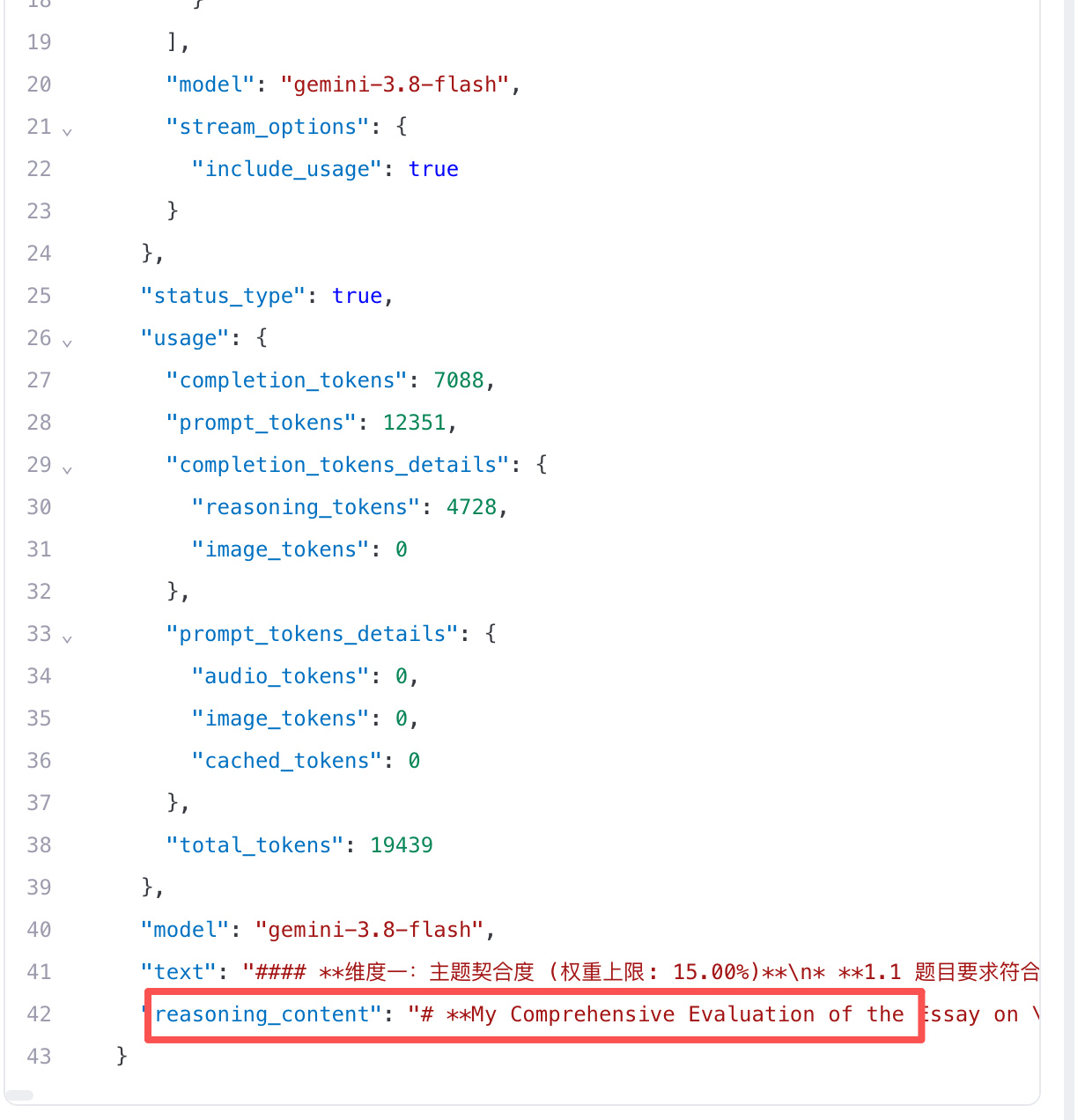
Gemini is multilingual and generates text token by token. Its output is influenced by the full available context, not only the latest instruction. Language choice is therefore better understood as context-sensitive generation than as a permanently fixed switch.
Why Gemini may suddenly use Chinese
1. The sources are primarily Chinese
Chinese webpages, documents, or product information can make Chinese text a locally plausible continuation, even when the question is in English.
2. The conversation already contains Chinese signals
Chinese entities, quotations, and previous messages can affect later output. Every turn adds context that may influence how Gemini will respond.
3. Multilingual generation happens token by token
The requested language is an important constraint, but it is not an absolute hardware-style toggle. Competing language patterns can remain present in the context.
4. The task has a long or complex context
Long-context reasoning and retrieval-based workflows contain more material to reconcile. According to the source project note, language consistency may decrease in these conditions.
Does stream=true cause Chinese output?
No. The streaming setting controls delivery:
stream=truereturns pieces of the response as they are made available.stream=falsereturns the response all at once.
Neither option instructs Gemini to use English or Chinese. A streamed request can contain language drift, but streaming is not the direct cause. Switching streaming off may change what the user sees and when, yet it does not function as language control.
How to handle an unexpected language switch
Follow these steps before drawing conclusions about the model.
Step 1: Audit the current conversation
Look for Chinese source text, quotes, named entities, product descriptions, retrieved pages, and earlier Chinese messages.
Step 2: Restate the output requirement
Place a direct instruction near the task:
Respond only in English, including the final answer.
Step 3: Reduce inherited context
If the conversation is long or multilingual, retry in a clean conversation with only the material needed for the task.
Step 4: Leave streaming configured for delivery
Choose stream=true when incremental output improves the experience and stream=false when a complete response is preferable. Do not choose between them as a language remedy.
Step 5: Preserve evidence when diagnosing a recurring issue
Record the current prompt, earlier turns, retrieved content, explicit language instruction, stream value, and exact response. A single excerpt rarely contains enough information to determine why the drift occurred.
What you should not conclude
Unexpected Chinese does not prove that Gemini secretly changed models. It also does not prove that streaming caused the change. Those explanations require evidence beyond the visible language of one response.
Public community posts describe similar unexpected changes involving Chinese, Japanese, and Portuguese. They are useful examples of a multilingual symptom, but they remain anecdotal and do not reveal Gemini's internal implementation.
Quick checklist
- Is Chinese present anywhere in the source material?
- Did an earlier
turnuse Chinese? - Is the conversation long, complex, or retrieval-heavy?
- Is the required output language stated near the current request?
- Are you treating
streamas delivery configuration rather than language configuration? - Have you preserved the full context needed to reproduce the issue?
FAQ
Did Gemini switch to a Chinese model?
An unexpected Chinese response does not establish that. Temporary multilingual language drift is the more consistent explanation described by the source material.
Will stream=false prevent language drift?
No direct causal relationship is identified. stream=false changes when the response is delivered, not which language is generated.
Is this problem unique to Chinese?
Apparently not. Public reports also mention Japanese and Portuguese, which is more consistent with a general multilingual behavior than a Chinese-only issue.
Can an explicit prompt guarantee English output?
An explicit instruction is a sensible mitigation, but the source material does not establish a guarantee.
Final takeaway
When Gemini unexpectedly responds in Chinese, investigate context before assuming a model change. Reassert the target language, simplify a mixed-language conversation when necessary, and keep generation concerns separate from streaming behavior.
For examples discussed in the source project, see community case 1 and community case 2.