With one request at a time, the median wait for the first words of a Kimi K3.1 Pro answer on ai& was 5.91 seconds. With ten requests in flight, the median rose to 8.57 seconds. All 45 requests in the ten-at-a-time test returned valid results.
Scores for the same model on two providers
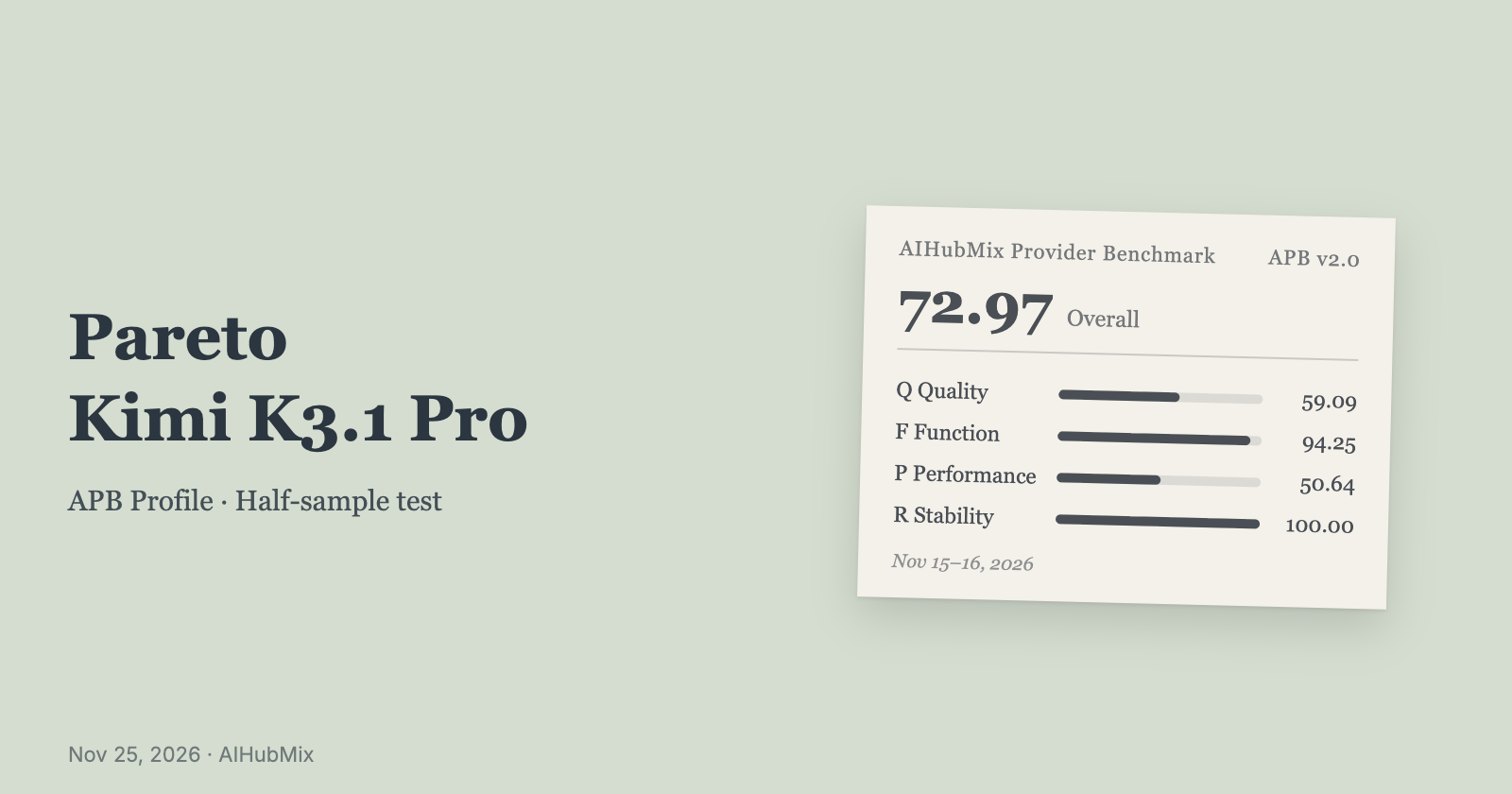
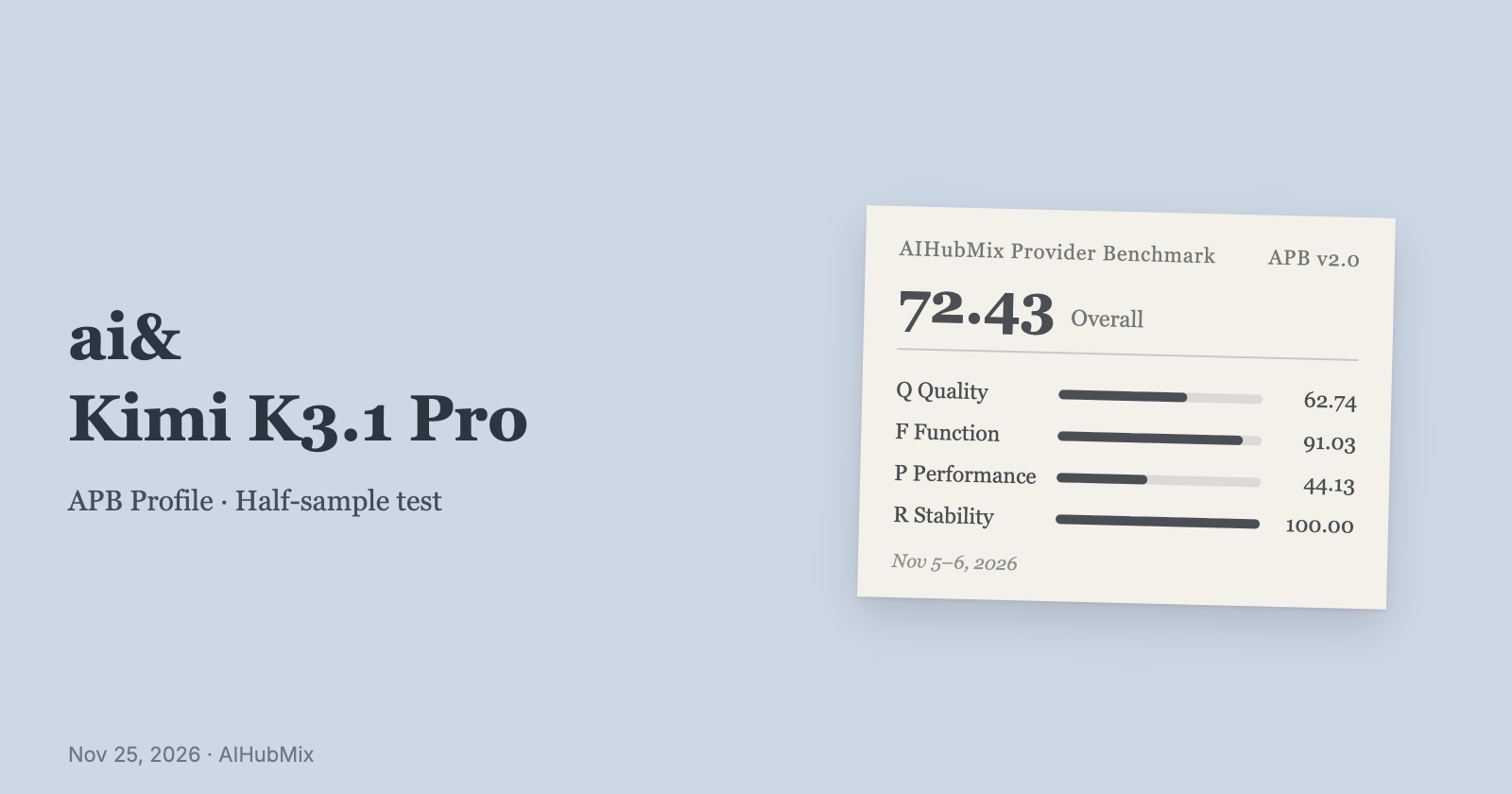
In November 2026, AIHubMix ran the half-sample version of its Provider Benchmark (APB) on Kimi K3.1 Pro at Pareto and ai&. The four measured scores and the overall score are each out of 100.
| Measure | Pareto | ai& |
|---|---|---|
| Answer quality (Q) | 59.09 | 62.74 |
| API functionality (F) | 94.25 | 91.03 |
| Performance (P) | 50.64 | 44.13 |
| Dedicated stability test (R) | 100.00 | 100.00 |
| Overall | 72.97 | 72.43 |
Answer quality (Q 62.74)
ai& answered 1,253 of 1,997 scored attempts correctly. The three suites covered tool calls (BFCL), hard reasoning questions (HLE) and reasoning over long documents (LCR). All 105 service failures counted toward answer quality occurred on HLE. Of the 953 scored HLE requests, 393 were correct (41.24%). Across the 848 requests that returned a gradable answer, accuracy was 46.34%.
| Suite | Collected | Correct / scored | Accuracy | Service failures |
|---|---|---|---|---|
| BFCL tool calling | 961 | 779/953 | 81.74% | 0 |
| HLE reasoning | 1,068 | 393/953 | 41.24% | 105 |
| LCR long context | 96 | 81/91 | 89.01% | 0 |
| Total | 2,125 | 1,253/1,997 | 62.74% | 105 |
On the automatically scored BFCL tasks, accuracy was 89.13% for a single tool and 89.95% for parallel calls to the same tool. When a task required a sequence of calls across turns, accuracy fell to 54.35%.
Results for all six BFCL tool tasks
| Tool task | Correct / scored | Accuracy |
|---|---|---|
| Single tool | 205/230 | 89.13% |
| Choose among multiple tools | 166/192 | 86.46% |
| Parallel calls to one tool | 170/189 | 89.95% |
| Parallel calls to multiple tools | 109/153 | 71.24% |
| No relevant tool | 79/97 | 81.44% |
| Multi-turn tool sequence | 50/92 | 54.35% |
API functionality (F 91.03)
In the November 5–6 run, ai& passed 68 of 75 judged API checks. Setting a stop sequence produced an empty answer twice. One named-tool call omitted the expected finish reason, and one response with tool history differed from the expected result. The endpoint also accepted three invalid inputs with HTTP 200.
In the post-fix checks, requests with a stop sequence kept their answer text, and named-tool calls returned the tool_calls finish reason. Both checks passed with and without streaming. Invalid parameters returned the expected HTTP 400.
| Group | Weight | Passed / judged | Excluded |
|---|---|---|---|
| Streaming | 20% | 14/15 | 0 |
| Tools | 20% | 14/15 | 0 |
| Output constraints | 20% | 13/14 | 1 |
| Context | 15% | 7/8 | 7 |
| Errors | 15% | 12/15 | 0 |
| Metering | 10% | 8/8 | 7 |
F weights the groups separately. Of the excluded checks, one encountered a network failure, 13 required exact native token counts and one was inapplicable.
How long it took to see an answer (P 44.13)
The clock started when the request was sent and stopped when the first answer text arrived. It included time spent on reasoning. Each group had 45 requests. Requests without a valid result ranked last in the first-text calculation. Three requests in the one-at-a-time group had no valid result.
| Wait | One at a time (42) | Ten at once (45) |
|---|---|---|
| Under 5 s | 14 | 8 |
| 5 to under 10 s | 26 | 20 |
| 10 to under 20 s | 2 | 17 |
| 20 s or more | 0 | 0 |
| Provider | Concurrency | First text (s) | TPOT (ms) | Valid requests |
|---|---|---|---|---|
| ai& | 1 | 5.91 | 4.68 | 42/45 |
| Pareto | 1 | 7.50 | 10.00 | 43/45 |
| ai& | 10 | 8.57 | 7.12 | 45/45 |
| Pareto | 10 | 10.54 | 11.69 | 42/45 |
With one request at a time, 40 of 42 valid requests started answering in under 10 seconds. With ten in flight, 28 of 45 did. TPOT is the average interval between answer tokens once the text starts. The table gives the median for each group, counting invalid requests at 50 milliseconds. Combined throughput at ten concurrent requests was 397.01 tokens per second. ai& scored 55.17 on response speed alone and 44.13 on performance with caching included.
How much of a repeated prompt came from cache?
The November 5–6 Chat Completions test sent the same opening text repeatedly. Three 8k repeats and four 32k repeats returned valid results. Across those seven requests, 151,808 input tokens were eligible for reuse. Every response reported cached_tokens=0, giving ai& a cache score of K = 0 in this test. One more 8k request timed out without reporting usage.
On November 24, all 20 requests to each of two endpoints, Chat Completions and Responses, succeeded. At each endpoint, all eight repeats that counted toward the cache score reported zero cached tokens.
| Date (UTC+8) | Endpoint | Hot hits / valid | Cached / eligible tokens |
|---|---|---|---|
| Nov 5–6 | Chat Completions | 0/7 | 0/151,808 |
| Nov 24 | Chat Completions | 0/8 | 0/159,744 |
| Nov 24 | Responses | 0/8 | 0/159,744 |
The repeats used fixed 8k and 32k prefixes, with hot requests spaced at 5, 30 and 120 seconds. The requests relied on automatic prefix caching, with no cache key, user field or explicit cache_control.
How often did production requests read from cache?
From November 18 to 24, 619 of 654 successful requests (94.65%) that AIHubMix sent to ai& through the Responses API reported a cache read.
By token count, ai& reported cache reads for 62,166,517 of the 64,332,718 input tokens in those successful requests (96.63%). Most came from long agent conversations. The median input was about 82,000 tokens per request.
Why were the overall scores only 0.54 points apart?
Response speed supplies 80% of measured performance and caching supplies 20%. Measured performance makes up 65% of the composite performance score, which carries 20% of the overall score. That gives caching an overall weight of 2.6% (20% × 65% × 20%). Even moving from zero to full marks on caching adds only 2.60 points out of 100.
In overall points, Pareto gained about 2.01 over ai& on caching (77.24 × 2.6%) and 0.52 on API functionality. ai& gained about 0.83 on answer quality and 1.16 on response speed. The two providers tied on stability, bringing the totals to 72.97 for Pareto and 72.43 for ai&.
Service stability (R 100.00)
All 150 requests in the stability test succeeded, including 61 short requests, 44 long requests, 30 tool requests and 15 multi-turn conversations. The 95% confidence interval for the success rate in this set was 97.57% to 100%. Service failures on the hard questions counted toward answer quality.
Test setup
On November 5–6, 2026 (UTC+8), the test sent HTTP/1.1 requests directly to ai&’s /v1/chat/completions endpoint using moonshotai/kimi-k3.1-pro. Reasoning effort was set to high, with a temperature of 1.0 for the answer tests and a limit of 16,384 output tokens for long reasoning tasks. The target request deadline was 300 seconds. Automatic retries and cross-provider fallback were disabled.
The answer tests collected 2,125 attempts across 775 questions. Functionality and speed each had 90 checks or requests, with another 150 requests in the stability test. HLE and LCR used deepseek-flash on the official DeepSeek provider route.