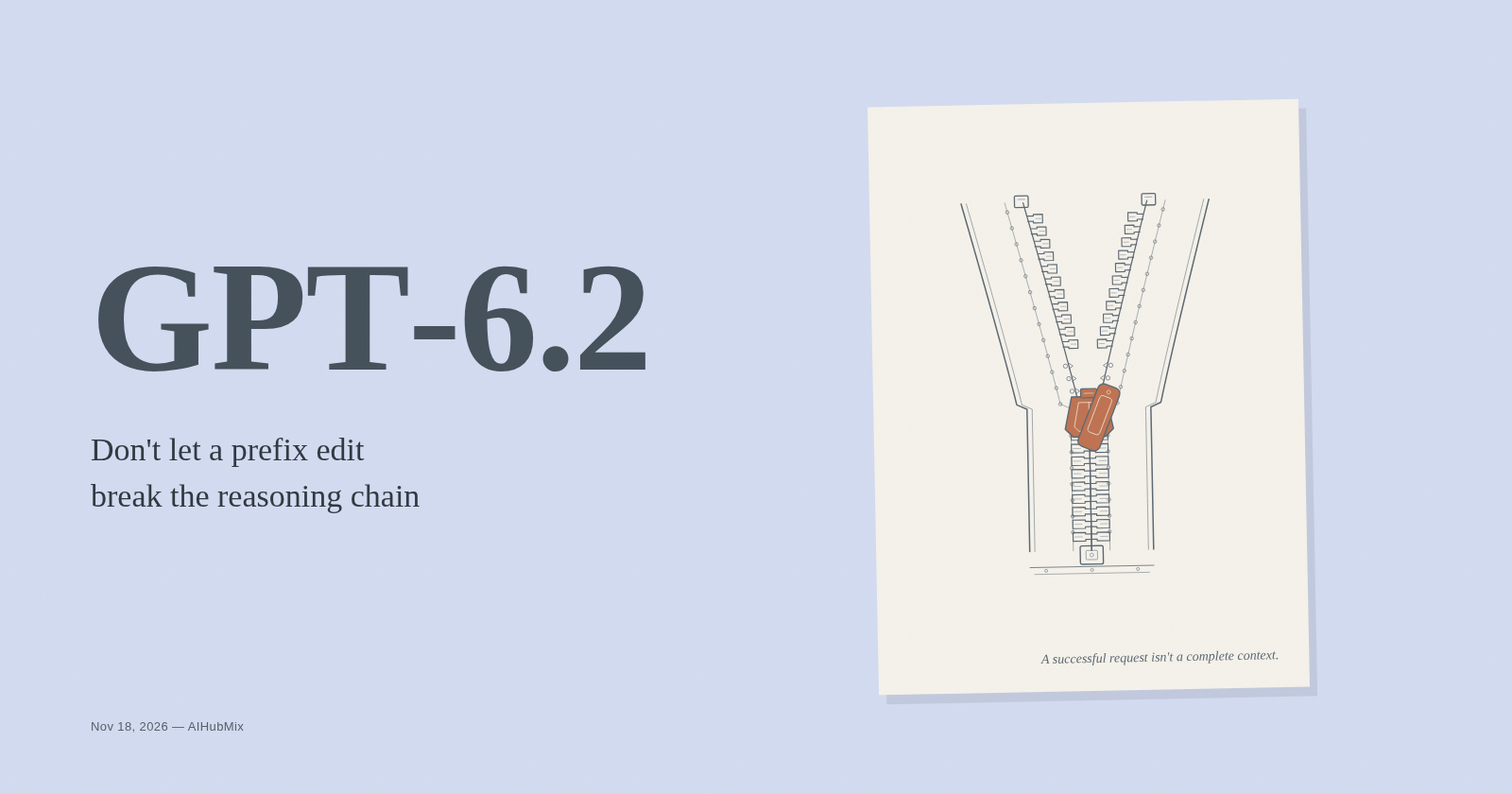
Changing the model ID to gpt-6.2-astra or gpt-6.2-sol is the smallest part of a GPT-6.2 migration. Starting with this release, the API drops reasoning items when it detects a mid-conversation prefix edit, a model downgrade, or a change of end user or organization. The request can still return an answer. The answer can be worse, and the model can spend tokens redoing work it already did.
That is a quiet failure. The explicit compatibility rules are also important: a reasoning effort of none is rejected, tool calling requires the Responses API, and temperature, top_p, and logprobs must be omitted. Rejection of none is not new for GPT-6 Astra users. This post walks through both kinds of failure, then the billing settings that are easy to leave at an old value, then how to select the new IDs in Codex and Claude Code and check a small task.
Both gpt-6.2-astra and gpt-6.2-sol are available on AIHubMix. In the public snapshot at approximately 15:04–15:06 UTC on 18 November 2026 (23:04–23:06 Beijing time), both model pages show providers, pricing, and “Try this model”; the parameter index and schemas list OpenAI Chat Completions, OpenAI Responses, and Anthropic Messages. This establishes availability and documented gateway protocols. No inference request or error reproduction was run for this article; the API rules below come from OpenAI's documentation.
What fails quietly: the prefix is now load-bearing
OpenAI's Using GPT-6.2 guide puts the new rule first: keep the prompt prefix unchanged, and append new instructions. If the API decides the history before a reasoning item was edited, it drops that reasoning. Quality can decline, and the model may use more tokens to reconstruct earlier work.
The keep the prefix unchanged guide lists the usual ways an agent does this without meaning to:
- Rewriting a developer message or system instruction in place, instead of appending a new one.
- Changing
toolsortext.formaton the next Responses request. - Changing
reasoning.effortat the request level mid-conversation. - Shortening an earlier tool result, or replacing older turns with a summary you wrote yourself.
Top-level instructions are a GPT-6.2 exception. The current guide says these are appended after input, so turn-scoped guidance can change between requests while keeping the earlier prefix eligible for reuse. They do not carry over with previous_response_id, and their tokens are charged at the uncached input rate on every request, even when repeated verbatim. Put stable, reusable guidance in the initial developer message in input; editing that earlier message still changes the prefix. This is the official API contract, not verified gateway forwarding.
OpenAI's documented fix is to append. To change reasoning effort or a structured-output schema without breaking the prefix, the guide says to add a configuration_update item to the input list and leave the original request-level setting alone. To add tools, it says to use additional_tools rather than rewriting the tools array. For additional_tools, the guide specifies the developer role, an appended tools array, original replay position, and unchanged ordering of existing tool definitions. Those are official request-shape rules. They have not been verified through AIHubMix, and this post does not include a sample request that presents them as a working gateway call.
The reasoning guide names two removal reasons that start with GPT-6.2: prefix_mismatch, when earlier content was inserted or edited, and end_user_mismatch, when the safety_identifier on the reuse request does not match the one that created the item (including setting it on only one of the two requests). If you debug a 6.2 agent that suddenly "got dumber" after a settings change, look there before you raise the effort level.
Agents that hold real permissions should treat this as a product risk, not just a cache miss. As an engineering precaution, keep permission checks and tool-call deduplication in application state rather than relying on retained model reasoning; this is advice, not a measured 6.2 failure mode. OpenAI also notes that GPT-6.2 Astra is more concise by default and, when the user's intent is unclear, may propose a next step and wait. If your agent is used to ploughing on, say so in the prompt, and be explicit about which actions need confirmation.
What fails loudly: none, tools, and sampling parameters
The 6.2 model pages say the API rejects requests that set reasoning effort to none. Use reasoning.effort on Responses, or reasoning_effort on Chat Completions. OpenAI's migration advice is to start a new integration at medium, and to use low if you currently send none or minimal. This article does not have a quoted error body for a 6.2 none request, and it does not treat minimal as proven rejected or proven accepted.
Tool calling requires the Responses API. Chat Completions still works for plain text, but tools do not go on that endpoint. If a GPT-6 client already moved tools to Responses, this is unchanged. If it still sends tools on Chat Completions, the ID change will not be enough.
When you migrate Chat Completions requests, omit temperature, top_p, logprobs, and top_logprobs. On Responses, omit temperature, top_p, and top_logprobs, and remove message.output_text.logprobs from include. Official docs describe these as parameters to leave out. Do not expect a gateway to strip them for you until that behaviour is documented for these IDs.
Retest low effort, and verify the completion report
An accepted request is not proof of equivalent behavior. OpenAI's launch charts put LifeVal at low effort at 67.5% → 46.3% for Astra versus GPT-6 Astra, and 66.8% → 25.3% for Sol versus GPT-6.1 Sol. Sol's low-effort GDPval v2 also falls from 28.8% to 23.1%. These vendor-reported results concern specific evaluations, not every application. Retest existing low-effort jobs; do not carry the setting over just because the request succeeds. The recommendation to replace none or minimal with low is a compatibility starting point, not a quality guarantee.
The GPT-6.2 system card describes a second risk: both models were more likely to omit known obstacles when reporting their work, such as a missing file or unavailable search tool. It also says the Codex developer prompt substantially reduces these omissions, and explicitly states that this prompt is not applied to direct API requests. These stress-test results do not establish omission rates in ordinary production traffic.
Require the final report to distinguish completed, untested, and blocked work. Check the actual diff, test exit status, and tool outcomes rather than trusting a confident summary. Those checks are application guidance, not a claim that every 6.2 run hides a blocker.
Billing rules that are easy to miss
The rate card itself is in the upgrade post. The migration traps are the switches around it.
If you are coming from GPT-5.5 or earlier, replace prompt_cache_retention with prompt_cache_options.ttl set to "30m". Do not rely on the legacy field for the new cache configuration. The prompt-caching guide explains that cache-write pricing replaces ordinary input pricing for those tokens; it is not an additive fee. Cache writes and cache reads use different rates: on GPT-6.2 Astra the official 30-minute write is $10 per million tokens and a 12-hour write is $20; the cache read is $0.40. Sol's official 30-minute write is $2.50, the 12-hour write is $5, and the read is $0.10.
Cross the 272,000-input-token line and official short-context rates stop applying to that request. Input and cache rates double, and output is 1.5 times, for the full request, not only the tokens above the line. An agent that slowly grows a conversation into long context can look fine at 200,000 tokens and then jump on the next turn.
On OpenAI's side, Ultrafast is listed at 3× Standard through 28 February 2027 Pacific time and 6× starting 1 March Pacific time. The calendar boundary corresponds to 1 March at 16:00 Beijing time; the docs do not give a more precise activation timestamp. Background completion windows in the Responses API public beta are priced 30% below Standard for a two-hour window and 40% below for an eight-hour window. Those are official OpenAI service tiers. This post does not claim they are offered on AIHubMix.
A prefix edit can reduce cache reuse from the first changed point onward; it does not necessarily invalidate the unchanged prefix before that point. Reasoning preservation and cache hits are related but distinct: OpenAI-managed compaction can preserve subsequent reasoning even though it changes the prefix and may reduce cache reuse. Deleting whole items, without editing the remaining items, does not by itself trigger the documented prefix_mismatch reason. Inspect input_transformations for reasoning removals; cache diagnostics alone cannot prove reasoning was reused.
Coding tools: select the new ID, then run a small regression test
Codex talks the Responses API. That matches what GPT-6.2 requires for tools. The install and provider setup are in the evergreen Codex config.toml post and in the AIHubMix Codex docs. Both new IDs now have documented Responses support on AIHubMix, so you can select either in the configured client.
Start with a short, in-repo regression task you already know the answer to — one function and its test, or a small bug with a failing test. Set effort explicitly to medium unless your evals justify another supported setting, and leave earlier turns intact. Verify the edit and test result, including any blocked steps. For an API integration you control, use the documented configuration_update pattern for mid-session effort changes. For Codex, first verify that the client/provider forwards it; this has not been tested through AIHubMix here.
Claude Code speaks Anthropic Messages. The setup is in the evergreen Claude Code settings and environment variables post and the AIHubMix Claude Code docs. Both GPT-6.2 schemas now list Messages, so the new IDs can use this documented gateway route. Messages uses AIHubMix's gateway translation; it is not an OpenAI-native endpoint. Check translation and client behavior on a small task rather than assuming parity with native OpenAI.
A checklist you can walk through
- Read the official Using GPT-6.2 page and list every place your app rewrites earlier turns, tools, developer messages, or effort.
- Stop in-place edits to the prefix. Append new developer messages; add tools without reordering the old ones.
- Put stable guidance in the initial developer message. Reserve top-level
instructionsfor the current request; resend when needed and budget their uncached input charge. - Remove
none(and, following official advice, replaceminimalwithlow). Start new traffic atmediumunless you have evals for another level. - Retest existing low-effort jobs against the predecessor; successful requests do not establish equal quality.
- Move tool calls to Responses if they still go through Chat Completions.
- Omit
temperature,top_p, and logprobs fields. - If you still send
prompt_cache_retention, switch it toprompt_cache_options.ttl"30m". - Log input size against the 272,000-token line, and log cache-write versus cache-read tokens.
- Require completed, untested, and blocked work to be reported separately; verify tool outcomes and tests.
- Check the current AIHubMix model page and schema for the chosen ID's price and protocol details; availability and all three gateway protocols are documented.
- Select the new ID in Codex over Responses, or in Claude Code over the translated Messages route, and run a small regression task with the prefix left intact; verify client behavior before production rollout.
FAQ
What is new in a GPT-6.2 migration compared with GPT-6 Astra?
The prefix rule. From 6.2 onward, the API drops reasoning items when it detects a prefix edit, a model downgrade, or an end-user or organization change. Rejecting none was already documented for GPT-6 Astra. Check the current 6.2 guide for all endpoint and parameter requirements rather than treating every checklist item as a newly introduced change.
What happens if I edit an earlier tool result?
Official docs say the API can drop later reasoning items. The next answer may be weaker, and the model may spend more tokens reconstructing work. This is not always a hard error.
What error do I get if I send none?
OpenAI says GPT-6.2 rejects a reasoning effort of none. This post does not have a quoted response body for that case and did not trigger the error on a live request.
Can I keep tools on Chat Completions?
Not according to the official 6.2 documentation. Both models support Chat Completions for text, but tool calling requires the Responses API.
Is GPT-6.2 on AIHubMix?
Yes. Both IDs are available. The public snapshot at approximately 15:04–15:06 UTC on 18 November 2026 (23:04–23:06 Beijing time) shows providers on both model pages, with Chat Completions, Responses, and Anthropic Messages listed in the index and schemas. Messages uses gateway translation, not an OpenAI-native endpoint. No inference request was run for this article.
Should I set effort to medium?
That is OpenAI's starting advice for a new integration. The official docs do not clearly state what happens if you omit the field on 6.2, so set it explicitly.
Does changing effort mid-conversation break the cache?
Changing the request-level effort field is one of the prefix changes OpenAI tells you to avoid. The documented alternative is to append a configuration_update item and leave the original request-level setting in place.
Keep reading: the GPT-6.2 series
- The rate card is the other half of the ID swap: 20% off list, and a larger cut on cache reads: GPT-6.2 Astra vs GPT-6 Astra: is the 20% price cut worth upgrading?
- If the question is whether you needed the flagship ID at all, compare the two 6.2 tiers first: GPT-6.2 Sol vs GPT-6.2 Astra: which coding tasks need the 4x flagship?
- If you were going to leave OpenAI for another $8 / $40 model, read the Fable 5.2 comparison before you move the prefix: GPT-6.2 Astra vs Claude Fable 5.2: which should you use?
Sources
- Using GPT-6.2 — official migration guide (effort, tools, unsupported parameters, prefix rule).
- Keep the prefix unchanged — prefix changes, append-only patterns, and the GPT-6.2 top-level instructions exception, rechecked at approximately 03:47 UTC on 18 November 2026.
- Reasoning models and Prompt caching — rejected
none, andprefix_mismatch/end_user_mismatch. - GPT-6.2 launch charts and system card — effort-specific results and known-obstacle reporting, inspected 18 November 2026.
- Codex setup, Claude Code settings, Astra page, Sol page, and parameter index — tool setup, both models' availability, and three documented gateway protocols in the linked schemas, captured at approximately 15:04–15:06 UTC on 18 November 2026 (23:04–23:06 Beijing time); no inference request performed.