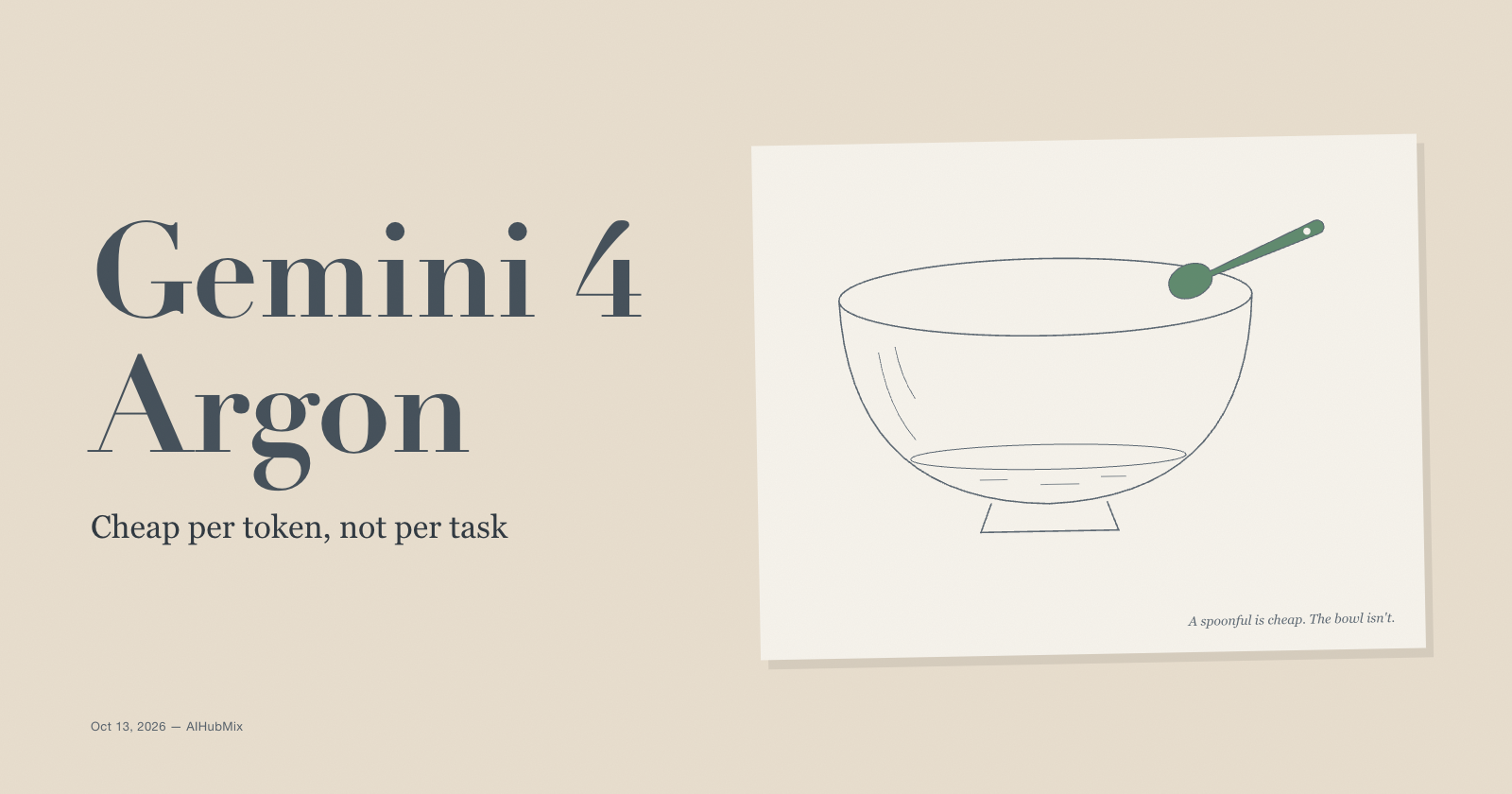
Gemini 4 Argon launched at $2 per million input tokens and $10 per million output tokens. That's a fifth of GPT-6 Astra's list price, and cheaper on output than Gemini 3.1 Pro Preview. On Artificial Analysis' benchmark tasks, Argon costs 60% of what Astra costs for the same score.
Two things make that number less comfortable than it looks. First, $2/$10 is a launch promotion: the standard price is $4/$20, and Google hasn't said when the switch happens. Second, Argon writes a lot: about 62k output tokens per Artificial Analysis task, roughly 2.3 times as many as Astra. At the standard price, Artificial Analysis' cost per task doubles from $1.99 to $3.98, about 1.2 times Astra's.
This post sets out what two independent testers measured per task, lists the billing rules that are easy to miss, and gives the levers that actually lower the bill. Anything Google hasn't published yet is marked TBD.
The price list
From Google's launch post, with earlier Gemini models from the Gemini API pricing page. All prices are USD per million tokens.
| Model | Input | Cached input | Output |
|---|---|---|---|
| Gemini 4 Argon, promo | $2.00 | $0.10 | $10.00 |
| Gemini 4 Argon, standard | $4.00 | TBD | $20.00 |
| Gemini 3.1 Pro Preview | $2.00 | $0.20 | $12.00 |
| Gemini 3.8 Flash, to Dec 31 | $0.75 | $0.075 | $3.75 |
| Gemini 3.8 Flash, from Jan 1 | $1.50 | $0.15 | $7.50 |
| GPT-6 Astra | $10.00 | — | $50.00 |
Gemini 3.1 Pro Preview prices are for prompts up to 200k tokens; above that they rise to $4 input and $18 output. GPT-6 Astra's price is as reported by Engadget.
Not published for Argon yet: when the promotion ends, the cached-input rate at standard pricing, a long-context surcharge, Batch and Flex rates, and cache storage. [TBD: Argon standard cache rate, long-context tier, Batch/Flex rates]
Artificial Analysis says the promotion runs "for at least one month" from September 30, 2026. Nobody has said whether the 95% cache discount outlasts it; Gemini 3.8 Flash's cache discount is 90%.
Cost per task: what independent tests measured
Figures in this section come from Artificial Analysis (its launch analysis and model pages) and Vals AI. Both ran Argon at high, its highest reasoning setting. Neither set of numbers comes from Google.
Artificial Analysis: promo and standard prices
Artificial Analysis runs every model through the same Intelligence Index tasks and reports the average cost of one task. It doesn't say how many tasks the index has.
| Model | Index score | Cost per task |
|---|---|---|
| Gemini 4 Argon (high), promo | 53 | $1.99 |
| Gemini 4 Argon (high), standard | 53 | $3.98 |
| GPT-6 Astra (max) | 53 | $3.26 |
| Gemini 3.1 Pro Preview | 30 | $1.30 |
Argon's promo token price is a fifth of Astra's, but its cost per task is three fifths of Astra's: an 80% discount per token shrinks to 40% per task. At standard prices it costs about 1.2 times as much as Astra. Artificial Analysis says the saving "is driven by lower token prices, rather than reduced token use". Argon averaged about 62k output tokens per task, against about 27k for Astra. Running the whole index, it generated 110M output tokens; the median model generated 85M, and Gemini 3.1 Pro Preview 67M.
Against Gemini 3.1 Pro Preview, Argon scores 23 points higher and costs about 1.5 times as much per task at promo prices, about 3 times at standard prices.
Vals AI: standard prices only
Vals AI ran Argon at the standard $4/$20 price, with temperature 1 and a 262,144-token output cap, and reports the average cost of one test.
| Model | Vals Index | Cost per test |
|---|---|---|
| Gemini 4 Argon | 68.90% | $15.68 |
| Claude Sonnet 5.5 | 67.04% | $21.34 |
| Claude Opus 5.5 | 66.97% | $32.14 |
| Claude Fable 5.1 | 65.83% | $28.71 |
On this suite Argon costs less per test than the three Claude models just below it, even at standard prices. The cost climbs on Vals' long agentic benchmarks:
| Vals benchmark | Argon score | Cost per test |
|---|---|---|
| CUA-bench | 4.83% | $193.78 |
| Code Migration | 68.17% | $57.82 |
| Terminal-Bench Science | 44.29% | $44.90 |
| SRE Bench | 44.28% | $30.45 |
CUA-bench, a computer-use benchmark, is the extreme case: the most expensive of these tests and one of Argon's weakest results, 7th of the 8 models Vals ran.
What the measured numbers show
- Against GPT-6 Astra, the promotion carries the saving. Argon matches Astra's score for 60% of the cost at promo prices and costs about 1.2 times as much at standard prices.
- Token count is the reason. Argon writes about 2.3 times as many output tokens per task as Astra, which eats half of its per-token discount.
- Against Claude, Argon is cheaper per test even at standard prices. On the Vals Index it costs $15.68 per test, against $21.34 to $32.14 for the next three Claude models.
- Long agentic runs are where the bill grows. On Vals' agentic benchmarks a single test costs between $30 and $194.
- Compare within one tester, not across them. Artificial Analysis quotes the promo price with the standard figure alongside; Vals uses the standard price. Their tasks and harnesses differ too.
Billing rules that are easy to miss
The promotion has no end date. Budget at $4/$20. If you set a monthly cap based on $2/$10, expect to hit it in roughly half the time once the promotion ends.
Thinking tokens may be billed as output. On Gemini 3 models, Google bills output "including thinking tokens". Argon isn't on Google's pricing page yet, so that's worth confirming for Argon.
A 1M output limit means a 1M output bill. One uncapped answer that runs to the limit costs $10 at promo prices and $20 at standard. Set an output cap on every request.
Long outputs may span several calls. Long Decode Continuation pauses and resumes long answers across follow-up calls. How those calls are billed, and whether earlier output is counted again as input, isn't documented. [TBD: Long Decode Continuation billing]
Cache hits depend on identical requests. The AIHubMix Gemini guide notes that an implicit cache hit needs the same content, model and parameters, with repeated context placed first. Changing the thinking level or reordering the prompt between turns can turn cached input back into full-price input.
Declined answers still cost money. Argon declines more often than other frontier models when it isn't sure. A declined answer still bills its input and thinking tokens, and retrying the same question on Argon pays again.
How to lower the bill
- Plan at the standard price. Treat the promotion as a bonus, not the budget.
- Cap output per request. Pick a cap that fits the job instead of leaving the 1M ceiling open.
- Put stable context first and keep it identical. System prompt, tool definitions and documents go at the top; the user's new message goes last.
- Fix the thinking level per workflow. Switching mid-session can break cache hits.
- Route by difficulty. Send extraction, classification and formatting to Gemini 3.8 Flash and keep Argon for the hard reasoning steps.
- Send declines somewhere cheaper. When Argon says it isn't sure, route the question to a person or another model rather than retrying Argon.
- Check Batch pricing when it appears. Gemini 3 models get 50% off through the Batch API; Argon's batch rate is TBD.
Estimate your own cost
A small calculator for your own token counts. The standard cached rate is a parameter because Google hasn't published it.
PRICES = {  # USD per 1M tokens
    "promo": {"input": 2.00, "cached": 0.10, "output": 10.00},
    "standard": {"input": 4.00, "cached": None, "output": 20.00},  # cached rate TBD
}


def task_cost(uncached_in, cached_in, output, tier="promo", cached_rate=None):
    p = PRICES[tier]
    cached = p["cached"] if p["cached"] is not None else cached_rate
    if cached is None:
        raise ValueError("Pass cached_rate: Argon's standard cached price isn't published yet")
    return (uncached_in * p["input"] + cached_in * cached + output * p["output"]) / 1_000_000


# Use token counts from your own logs, e.g. the usage field of the same workflow
# run on Gemini 3.8 Flash: task_cost(uncached_in, cached_in, output, "promo")
Measure real token counts on Gemini 3.8 Flash or 3.1 Pro Preview through AIHubMix first. Expect Argon's to be higher: on Artificial Analysis' index it generated 110M output tokens where Gemini 3.1 Pro Preview generated 67M. Treat the result as a floor, not a forecast.
On AIHubMix
Argon has a model page on AIHubMix, but it's marked coming soon and its AIHubMix price isn't set yet. [TBD: AIHubMix price for Gemini 4 Argon]
In the meantime, Gemini 3.8 Flash is the cheapest way to prototype the same workflow, and Argon's price will appear on its model page once it's set.
FAQ
How much does Gemini 4 Argon cost?
During the launch promotion, $2 per million input tokens, $0.10 per million cached input tokens and $10 per million output tokens. The standard price is $4 input and $20 output.
When does the Gemini 4 Argon promotion end?
Google hasn't said. Artificial Analysis reports it runs for at least one month from September 30, 2026.
Is Gemini 4 Argon cheaper than GPT-6 Astra?
Per token, yes, by a wide margin. Per task, it's about 60% of Astra's cost at promo prices and about 1.2 times Astra's cost at standard prices, because Argon writes more tokens.
Why does Argon cost more per task than its token price suggests?
It averages about 62k output tokens per benchmark task, against about 27k for GPT-6 Astra, and output tokens are the expensive ones.
Does context caching work with Gemini 4 Argon?
Yes. Cached input is 95% off during the promotion. The cached rate at standard pricing hasn't been published.
What does one task cost on Argon in independent tests?
On Artificial Analysis' Intelligence Index, $1.99 per task at promo prices and $3.98 at standard prices. On the Vals Index, run at standard prices, $15.68 per test, below the $21.34 to $32.14 of the next three Claude models, rising to $193.78 per test on the CUA-bench computer-use benchmark.
Is there a cheaper Gemini model for simpler tasks?
Gemini 3.8 Flash costs $0.75 input and $3.75 output per million tokens through December 31, 2026, and suits extraction, classification and routine chat.
Keep reading: the Gemini 4 Argon series
- Before budgeting, check whether Argon is the right model for the job at all: Gemini 4 Argon: Frontier Scores, a 1M-Token Output Limit, and No Public Model ID Yet
Sources
- Gemini 4 Argon: our next era of frontier intelligence (Google)
- Gemini Developer API pricing (Google AI for Developers)
- Gemini 4 Argon: Google is back as one of the top three labs in intelligence achieved (Artificial Analysis)
- Gemini 4 Argon benchmarks, cost and capabilities (Vals AI)
- Gemini 4 Argon on AIHubMix (AIHubMix)