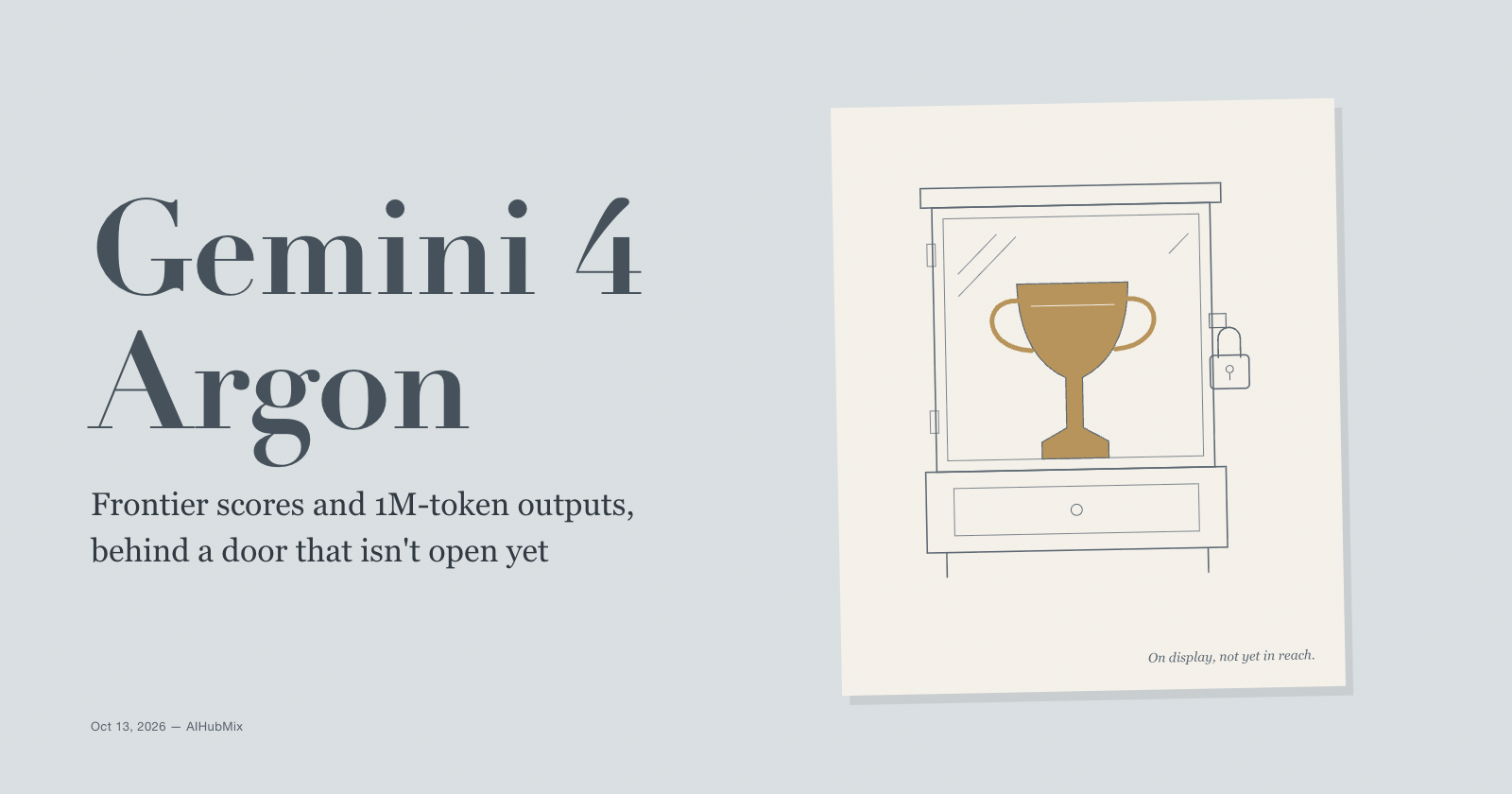
Gemini 4 Argon is Google's first Gemini 4 model and its strongest so far. Independent testers put it level with GPT-6 Astra, it tops the Vals Index for finance, legal and tax work, and it can write up to 1M tokens in a single answer. During its launch promotion it also costs less per token than Astra.
The catch is access. As of October 13, 2026, Argon is rolling out only to cyber defenders in Google's Fairwind Program. Google hasn't published a model ID, it isn't in the Gemini API model list, and it isn't available on AIHubMix yet. This post covers what changed, where Argon wins and where it doesn't, and who should start planning for it.
The short version
- Argon replaces Gemini 3.1 Pro Preview at the top of Google's lineup. It is Google's first new model above the Flash tier in more than seven months.
- On the Artificial Analysis Intelligence Index it scores 53, the same as GPT-6 Astra at max reasoning and 23 points above Gemini 3.1 Pro Preview.
- It has the lowest hallucination rate of any top-scoring model on Artificial Analysis' test (15%), but it also answers fewer of those questions correctly than Astra.
- It trails Claude Opus 5.5 and GPT-6 Astra on terminal-heavy coding and computer use.
- Introductory price: $2 input and $10 output per million tokens, rising to $4 and $20. Google hasn't said when the promotion ends.
- Who can call it today: Fairwind members. Paid API customers and Google AI Ultra subscribers come next, with no date.
What changed from Gemini 3.1 Pro Preview
Google's launch post frames Argon around "long-horizon" work: real-world software engineering, enterprise knowledge work such as legal and finance, and cyber defense. The biggest concrete change is the output ceiling.
| Gemini 3.1 Pro Preview | Gemini 4 Argon | |
|---|---|---|
| Max output | 64K tokens | 1M tokens |
| AA Intelligence Index | 30 | 53 |
| AA cost per index task | $1.30 | $1.99 promo / $3.98 standard |
| Input / output price | $2 / $12 | $2 / $10 promo, then $4 / $20 |
| Who can use it | Public preview | Fairwind Program only |
3.1 Pro Preview prices are for prompts up to 200k tokens ($4 / $18 above that). Argon hasn't published a long-context price tier.
A 1M-token output limit. Earlier Gemini models stopped at 64K output tokens. Argon can keep going to 1M, using a new Gemini API feature called Long Decode Continuation that pauses a long response and resumes it across follow-up calls so it doesn't time out. Google's own examples show why this matters: its agents have used Argon for C and C++ to Rust migrations, including more than 800K lines of the Fuchsia Zircon kernel, and for one library replaced 32K lines of SIMD code with safe Rust that runs 2.7 times faster than the earlier Rust port. Those are jobs where a 64K cap forced you to chunk the work by hand.
A new naming scheme. There's no Pro or Flash label, just a generation number and a codename. Google had planned a Gemini 3.5 Pro earlier in 2026 and moved past it.
A gated launch. Argon was trained specifically for defensive cyber work, and Google says it can "autonomously find, validate, and patch critical software vulnerabilities." Fairwind members and Google's internal teams get a version without cyber guardrails. The wider release will refuse harmful cyber, chemical, biological, radiological and nuclear requests.
What stayed the same. Output is still text only. Inputs cover text, images and video (Artificial Analysis also lists speech). Third-party testers report a 1M-token context window; Google's launch post doesn't state the input limit. [TBD: official context window]
How it compares with GPT-6 Astra, Claude Opus 5.5 and Fable 5.1
The table below comes from Google DeepMind's benchmark table. Google ran Argon at its highest thinking setting and mostly used rivals' self-reported or public-leaderboard numbers, so treat it as vendor data. Artificial Analysis and Vals AI have published independent results, quoted after the table.
| Benchmark | Argon | GPT-6 Astra | Fable 5.1 | Opus 5.5 |
|---|---|---|---|---|
| Vals Index | 68.9% | 63.1% | 65.8% | 67.0% |
| Vals Finance Agent v2 | 65.4% | 53.5% | 58.9% | 58.6% |
| Harvey Legal Agent | 19.6% | 5.4% | 6.7% | 3.8% |
| DeepSWE v1.1 | 77.9% | 74.1% | 67.4% | 74.2% |
| FrontierSWE v2 | 55.0% | 65.5% | 56.3% | 62.3% |
| Terminal-bench 4.0 | 57.4% | 58.2% | 57.9% | 66.4% |
| OSWorld-2.0 | 69.2% | 72.6% | — | — |
| GraphWalks 256k–1M | 84.2% | 71.8% | 65.0% | 66.8% |
| LVBench | 91.7% | 87.5% | 79.7% | 83.7% |
| CWE-bench v1 | 68.0% | 68.0% | 58.0% | 67.0% |
OSWorld-2.0 is the offline subset, partial score. GraphWalks is F1. The full table has 19 rows; Argon leads or ties 14 of them.
Three patterns stand out:
- Knowledge work is where the gap is widest. On Harvey's legal agent benchmark Argon scores 19.6% against at most 6.7% for the others. On Finance Agent v2 the lead is more than six points.
- Very long inputs hold up. On GraphWalks between 256k and 1M tokens, Argon keeps 84.2% where the others fall to around 65–72%.
- Coding is mixed. Argon leads DeepSWE but trails on FrontierSWE (Astra) and Terminal-bench 4.0 (Opus 5.5).
The independent numbers broadly agree. Artificial Analysis scores Argon (high) at 53 on its Intelligence Index, tied with GPT-6 Astra (max) and one point ahead of GPT-6.1 Sol (max). Its Terminal Bench 4 run puts Argon at 57%, behind Claude Sonnet 5.5, Claude Opus 5.5 and GPT-6 Astra. Vals ranks Argon first of the models on its index, with its best single result on Finance Agent v2, and lists computer use (CUA-bench) as a weak spot.
The trade behind "low hallucination"
Artificial Analysis' Omniscience test asks hard factual questions and penalises confident wrong answers. Argon's hallucination rate is 15%, the lowest of any model scoring 45 or more on the index; GPT-6 Astra's is 51%. But Argon's accuracy on the same questions is 50%, against 63% for Astra. Argon gets its low hallucination rate by declining to answer when it isn't sure, not by knowing more.
For legal and financial review that is often the right trade: a refusal is easy to spot and route to a person or another model, while a confident wrong figure can slip past a reviewer. It only pays off if your application has somewhere to send the questions Argon declines.
Where Argon is not the best choice
- Terminal-heavy coding agents. Google's own table has Opus 5.5 at 66.4% on Terminal-bench 4.0 against Argon's 57.4%, and Artificial Analysis' run agrees on the order.
- Computer use. Astra leads OSWorld-2.0, and Vals ranks Argon seventh of eight on CUA-bench.
- Questions that need an answer every time. A 50% Omniscience accuracy means many "I'm not sure" responses on hard factual recall.
- Latency-sensitive work. Argon averaged about 62k output tokens per Artificial Analysis task, against about 27k for Astra. Google hasn't published speed figures. [TBD: output speed and time to first token]
- Anything that has to ship this quarter. You can't call it yet.
Who should switch, wait, or stay
| Workload | What to do now |
|---|---|
| Finance, legal and tax agents | Plan for Argon |
| Long documents and long video | Plan for Argon |
| Large code migrations | Plan for Argon |
| Terminal-heavy coding agents | Stay on Opus 5.5 or Astra |
| Computer-use agents | Stay put |
| High-volume, cost-sensitive jobs | Use Gemini 3.8 Flash |
| Security teams in Fairwind | Use Argon now |
"Plan for Argon" means: prototype the workflow on Gemini 3.8 Flash or 3.1 Pro Preview today, budget at Argon's standard price, and swap the model ID when access opens.
Getting ready on AIHubMix
Argon has a model page on AIHubMix under the ID gemini-4-argon, but it's marked coming soon and has no price yet. [TBD: AIHubMix availability date]
You can build the workflow now on the Gemini models AIHubMix already serves, such as Gemini 3.8 Flash, and keep the model ID in configuration. The OpenAI-compatible endpoint works with the standard OpenAI SDK; the AIHubMix Gemini guide also covers the native Google SDK.
import os
from openai import OpenAI

client = OpenAI(
    base_url="https://aihubmix.com/v1",
    api_key=os.environ["AIHUBMIX_API_KEY"],
)

# AIHubMix lists Argon as gemini-4-argon (coming soon). Prototype on
# Gemini 3.8 Flash, then set ARGON_MODEL_ID=gemini-4-argon once it opens.
MODEL = os.environ.get("ARGON_MODEL_ID", "gemini-3.8-flash")

resp = client.chat.completions.create(
    model=MODEL,
    reasoning_effort="high",
    messages=[
        {"role": "user", "content": "List the termination clauses in the contract below. Say so if you are unsure about any of them.\n\n<contract text>"},
    ],
)
print(resp.choices[0].message.content)
On the OpenAI-compatible route, reasoning_effort maps to Gemini's thinking settings. Which values Argon accepts isn't documented yet. [TBD: Argon reasoning levels on AIHubMix]
When Argon opens on AIHubMix, its price and supported parameters will show on that model page.
FAQ
Can I use Gemini 4 Argon through the API today?
Only if your organisation is in Google's Fairwind Program. Paid API customers and Google AI Ultra subscribers are next in line, but Google hasn't given a date.
What is Gemini 4 Argon's model ID?
Google hasn't published one. On AIHubMix, Argon is listed as gemini-4-argon on a model page marked coming soon. A call to that ID through Google's own API returned a 404 error on October 1.
Is Gemini 4 Argon better than GPT-6 Astra?
On Artificial Analysis' index they tie. Argon leads on knowledge work, long-context retrieval and video understanding; Astra leads on FrontierSWE, terminal science tasks and computer use.
Is Gemini 4 Argon good for coding?
It's strong on DeepSWE and Vibe Code Bench, but Claude Opus 5.5 and GPT-6 Astra still lead on terminal-heavy agentic coding.
What does the 1M-token output limit mean in practice?
A single job can produce far more than the old 64K cap, such as a large code migration or a long report. Google says this relies on Long Decode Continuation, which pauses and resumes long responses across calls.
Why is the hallucination rate low but the accuracy only 50%?
Argon declines to answer more often when it isn't sure. That lowers confident wrong answers but also lowers the share of questions it answers correctly.
When will Gemini 4 Argon be on AIHubMix?
No date yet. Its AIHubMix model page is up but marked coming soon. Build on Gemini 3.8 Flash or 3.1 Pro Preview through AIHubMix now and switch the model ID when Argon opens.
Keep reading: the Gemini 4 Argon series
- The $2/$10 launch price looks cheap until you count tokens per task. The measured cost per task is here: Gemini 4 Argon Pricing: Cheap Per Token, Not Per Task
Sources
- Gemini 4 Argon: our next era of frontier intelligence (Google)
- Gemini models and benchmarks (Google DeepMind)
- Gemini 4 Argon: Google is back as one of the top three labs in intelligence achieved (Artificial Analysis)
- Gemini 4 Argon benchmarks, cost and capabilities (Vals AI)
- Gemini 4 Argon on AIHubMix (AIHubMix)