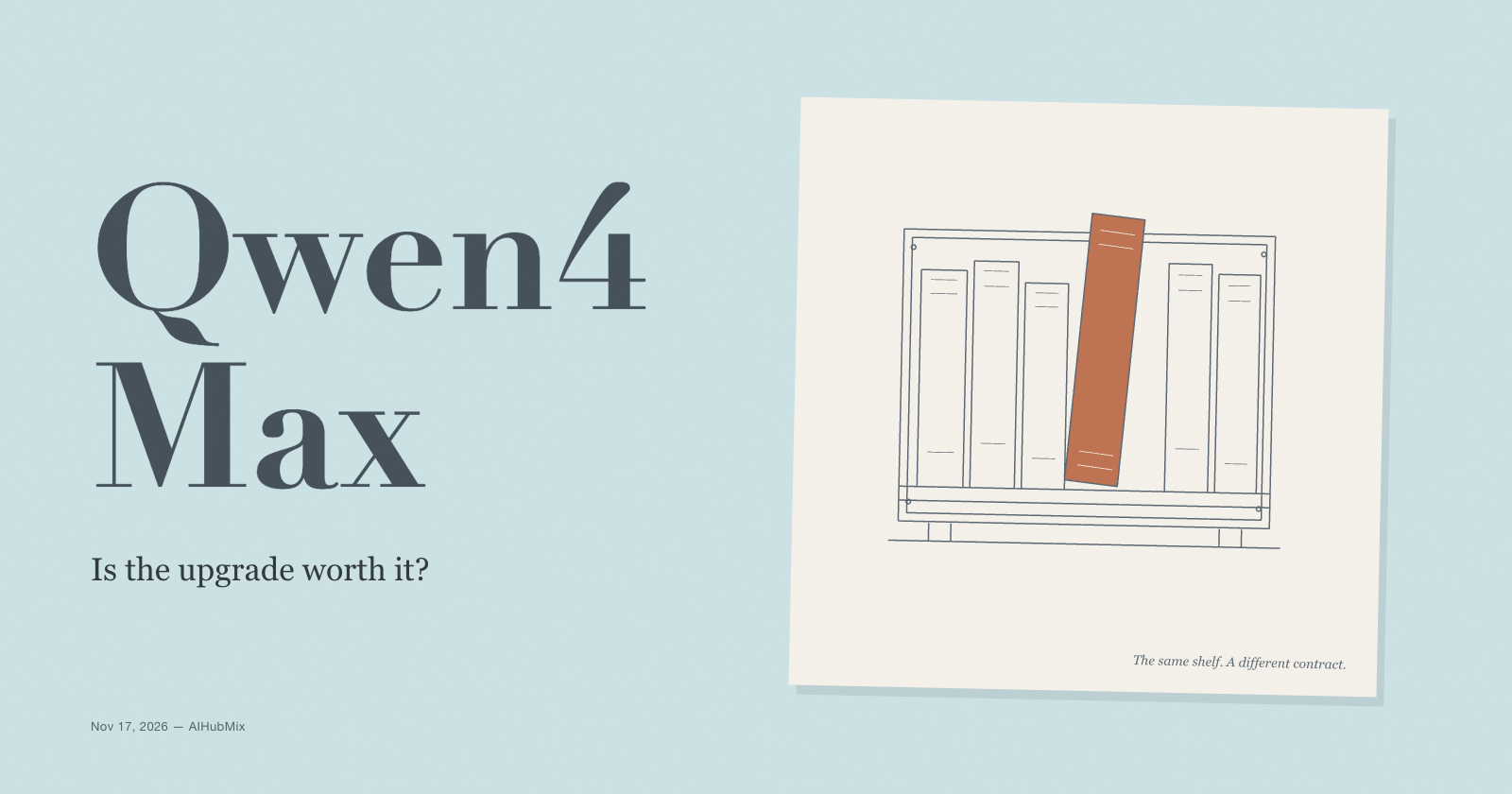
Qwen4-Max is worth evaluating if you already use Qwen3.8-Max: ordinary input and output prices are 25% lower at Alibaba Cloud's Singapore list rates. The context window stays at one million tokens, and both accept text, images, and video. That makes price the clearest documented reason to try the upgrade. It does not establish that the new model solves your tasks better or uses fewer tokens.
The migration also changes an integration contract. An answer-only output cap can now limit thinking and the answer together, and the default effort changes from xhigh to high. Budget for that change before replacing a production model ID.
What stays the same, and what changes
Alibaba's Qwen4-Max model page and Qwen3.8-Max documentation describe two cloud models with the same context size and input modalities. Their output limits need more careful reading:
| Item | Qwen3.8-Max | Qwen4-Max |
|---|---|---|
| Context | 1,000,000 | 1,000,000 |
| Input | Text, image, video | Text, image, video |
| Non-thinking output | 131,072 | 131,072 |
| Thinking enabled | Default | Default |
| Default effort | xhigh | high |
| Native effort levels | low, medium, xhigh | low, high, xhigh |
Qwen4-Max allows up to 262,144 tokens for thinking and the answer combined. Qwen3.8-Max's documented 131,072 output limit is an answer limit, including in thinking mode, with a separate maximum chain-of-thought length of 262,144. Those figures have different scopes; they do not support a claim that output capacity simply doubled.
Both models can take visual input, so an application already sending screenshots or document images does not gain a new input type merely by upgrading. Whether extraction or visual reasoning improves needs a comparison on representative files.
The price difference on a fixed workload
The official pricing table lists these Singapore USD rates for both thinking and non-thinking modes, with input up to one million tokens per request:
| Per million tokens | Qwen3.8-Max | Qwen4-Max |
|---|---|---|
| Ordinary input | $2.00 | $1.50 |
| Output, including thinking | $6.00 | $4.50 |
Consider cumulative usage across multiple requests: one million uncached input tokens and 100,000 output tokens, including reasoning. These are totals, not a single request. Qwen3.8-Max costs $2 + $0.60 = $2.60; Qwen4-Max costs $1.50 + $0.45 = $1.95. That is 25% less for identical usage. This is an estimate, not a measured task result, and excludes caching, tools, retries, and tax. Other regions have different prices.
Actual savings depend on completion behavior. More reasoning, repeated attempts, or longer histories can offset a lower unit price. Compare the bill for an accepted result, alongside its correctness, rather than assuming each task becomes 25% cheaper.
Audit the output cap and thinking settings
The Chat Completions reference says Qwen4-Max treats max_tokens as equivalent to max_completion_tokens: both cover thinking plus answer. Qwen3.8-Max's max_tokens covers the answer. A small inherited cap can therefore stop the new model before a useful answer appears. Check finish_reason; length means the budget was exhausted. No new inference experiment is reported here.
For new Qwen4-Max integrations, prefer max_completion_tokens and choose room for both kinds of output. Its native effort values are low, high, and xhigh; medium maps to high. On Qwen3.8-Max, high maps to xhigh. Reusing an enum does not necessarily reuse its meaning.
When effort and thinking budget are both omitted, Qwen4-Max defaults to high and 131,072 thinking tokens. Do not send reasoning_effort and thinking_budget together. An explicit thinking budget must be positive; use the documented thinking switch, rather than a zero budget, to disable thinking. Retain historical reasoning in its own field instead of concatenating it into answer text.
What the gateway establishes
The AIHubMix Qwen4-Max guide lists qwen4-max on Chat Completions but marks capability flags as unverified. Alibaba's support for tools, structured output, Responses, and Messages does not establish that every path works through this gateway.
Alibaba also documents Qwen4 explicit caching, including automatic breakpoints and 5-minute or 1-hour TTL. Its write premiums and separate read charges need their own accounting. Optional thinking summaries require preserving encrypted history. Verify those controls on your intended route before relying on them for savings or multi-turn behavior.
Start with a small set of real tasks: one repository change, one long-document question, and one visual case if your application uses images. Keep prompts, tools, and acceptance criteria fixed. Record accepted results, total tokens including retries, and failures. Keep Qwen3.8-Max available until the replacement passes. The AIHubMix comparison page helps check listed specs and prices; your acceptance tests decide the upgrade.
FAQ
Is Qwen4-Max cheaper than Qwen3.8-Max?
At official Singapore rates, ordinary input and output are each 25% lower. Actual task savings depend on token usage and retries.
Does context increase?
No. Both list a 1,000,000-token context window.
Does Qwen4-Max double the output limit?
The listed limits use different scopes. Qwen4-Max caps thinking plus answer at 262,144; Qwen3.8-Max's 131,072 is an answer limit.
Can the old max_tokens setting carry over?
Audit it first. Qwen4-Max includes thinking in that cap, so a limit sized for an answer may be insufficient.
Did the default thinking level change?
Yes: xhigh on Qwen3.8-Max becomes high on Qwen4-Max. Some compatibility mappings also differ.
Should all production traffic move immediately?
Move after representative tasks and required gateway features pass. The documented price reduction does not prove a quality improvement.
Keep reading: the Qwen4-Max series
- For the configuration changes behind this decision, read Qwen4-Max migration: output limits, thinking, and agent setup.
- To compare another flagship on the same repository task, read Qwen4-Max vs Kimi K3.1 Pro: which coding agent should you use?.
Sources
- Alibaba Cloud: Qwen4-Max and Qwen3.8-Max, model limits and defaults.
- Alibaba Cloud: model pricing, Singapore USD rates; arithmetic assumes identical uncached usage.
- Alibaba Cloud: Chat Completions reference, output-cap scope and thinking parameters.
- Alibaba Cloud: Qwen4 cache and thinking summary and encryption, vendor features.
- AIHubMix: Qwen4-Max guide and Qwen3.8-Max guide, gateway listings. Sources checked November 17, 2026, 02:33 UTC; no new inference tests.